
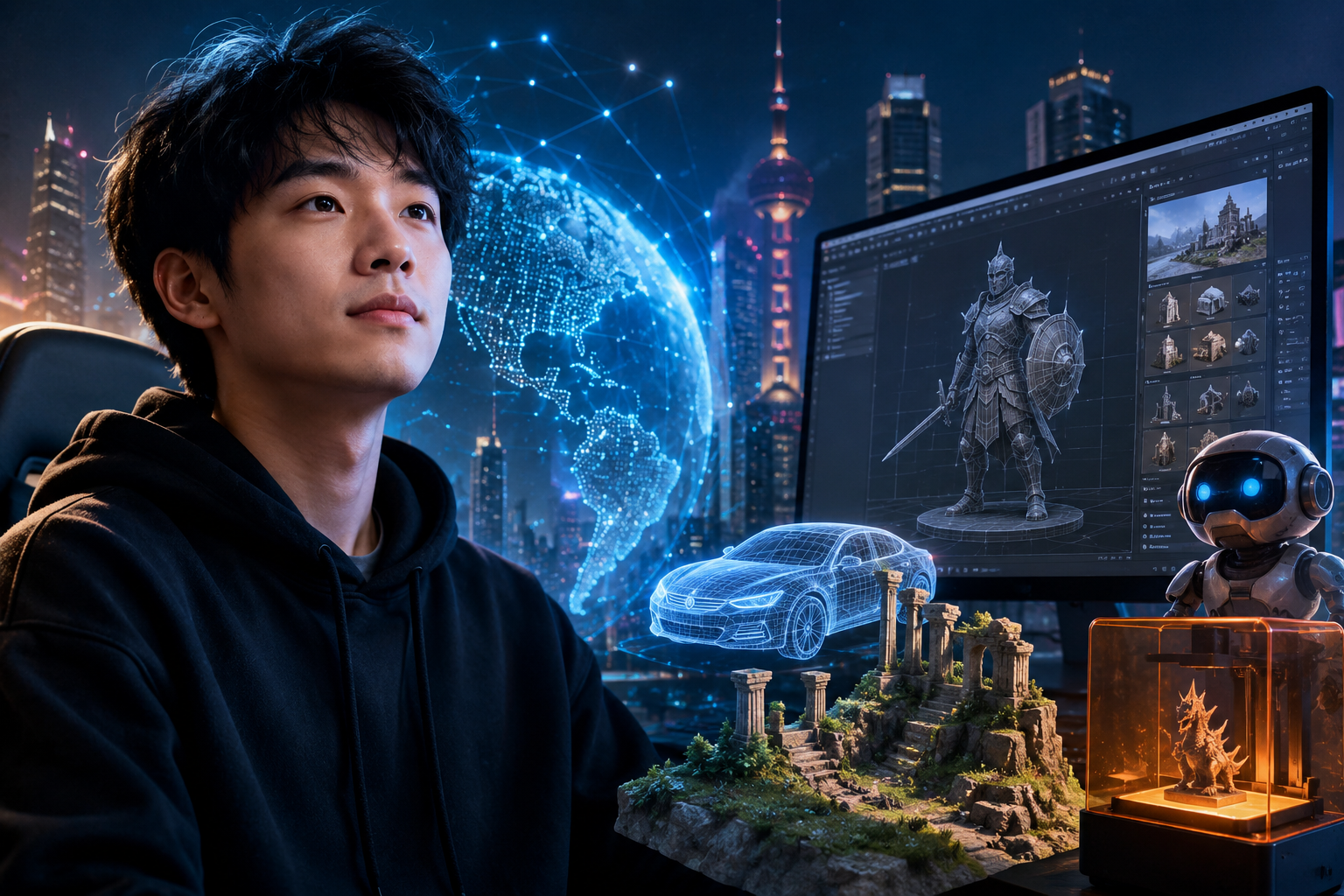
create 3D models from simple text or image prompts. Many people now see this area as the next big step in artificial intelligence. Experts believe AI may soon help people build games, films, virtual spaces, and digital products much faster than before.
Vast started only in 2023, but the company already has millions of users across many countries. Investors now believe the startup could become a major force in the future of digital content.
Simon Song Turns Passion Into Business
The founder of Vast is Simon Song. Before he built the company, he spent years as a gamer and AI researcher. His love for games helped shape his vision for the startup.
Song understood how much time game studios spend on 3D design. Artists often need many days or even weeks to create high-quality objects and virtual scenes. He believed AI could shorten this process and reduce costs.
Instead of only talking about the idea, Song built tools that allow users to type a prompt and receive a 3D object within minutes. This simple concept quickly attracted developers, designers, and creators from around the world.
His journey also reflects a larger trend in China. Many young entrepreneurs now enter the AI industry with bold ideas and strong technical skills. Investors actively search for startups that can compete on a global level.
Vast Raises Nearly 200 Million Dollars
Vast recently raised close to 200 million dollars in a major funding round. This investment pushed the company’s value above 1 billion dollars, which officially gave it unicorn status.
Large investors backed the deal, including funds connected to China Life Insurance. Earlier support also came from major technology companies such as Alibaba and Baidu. Their interest shows strong confidence in the future of AI-powered 3D creation.
The funding gives Vast more power to expand its products, hire workers, and improve research. The company also plans to strengthen its position in international markets where demand for AI tools continues to rise.
Many startups struggle to gain investor trust, especially in competitive AI sectors. Vast managed to stand out because it entered a market that still has huge room for growth.
The Main Product Behind the Success
The company’s main platform is called Tripo Studio. This tool creates 3D models from text descriptions or uploaded images. Users can type a few simple words and receive a digital object in a short time.
For example, someone can ask the system to create a fantasy castle, a racing car, or a game character. The AI then produces a 3D version that users can edit or place inside projects.
This technology helps many industries. Game developers can build worlds faster. Film studios can create digital scenes with less effort. Product designers can test ideas before real production begins. Even people with little design experience can now create detailed 3D objects.
Vast says its latest AI models produce results that need less manual correction than many competing systems. This advantage may help the startup attract more professional users.
Millions of Users Across the World
The startup already claims around 20 million users. Most users come from the United States, but the platform also has strong interest from Europe, Japan, and South Korea.
This global reach is important because many Chinese startups often depend heavily on the local market. Vast, however, built a product with international demand from the start.
The company follows a subscription model. Basic plans begin at around 20 dollars per month, while larger usage requires extra payment. This business structure creates a steady stream of income and supports future expansion.
The fast growth also shows how quickly AI tools now spread across borders. A useful product can gain worldwide attention within a very short time.
Why 3D AI Has Huge Potential
For years, AI mostly focused on text, images, and chatbots. Now many experts believe 3D generation may become the next major technology shift.
3D models play a central role in modern digital experiences. Video games depend on them. Animated films use them heavily. Virtual reality and augmented reality also require detailed digital objects and environments.
If AI can automate much of this work, companies may save large amounts of time and money. Small creators may also gain access to tools that once required huge budgets.
Simon Song believes 3D models may become even more important than language models because they represent the physical world in a structured form. His vision goes beyond simple objects. He wants AI to help create complete virtual spaces.
Project Eden Shows the Bigger Dream
Vast now works on another system called Project Eden. This project aims to generate full 3D environments instead of single objects.
The idea could change how people build digital worlds. Instead of designing every building, road, tree, or mountain by hand, creators may simply describe the world they want. The AI would then produce a complete environment.
This technology could transform video game development. Large open-world games usually require massive teams and years of work. AI-generated environments may reduce production time in the future.
Film production may also benefit. Directors could create digital movie sets quickly without large design departments. Architects and city planners may even use similar systems for visual projects.
Although the technology still needs improvement, many investors already see huge business potential.
Competition Continues to Grow
Vast does not stand alone in this race. The company faces competition from Chinese tech giant Tencent and Silicon Valley startup Meshy.
Many firms now enter the AI 3D sector because demand continues to rise. Companies hope to become leaders before the market fully matures.
Still, competition also pushes innovation. Startups must improve speed, quality, and ease of use. Users will likely choose platforms that deliver the best results with the least effort.
Right now, Vast appears to hold strong momentum because of its rapid growth and large user base.
The Future of AI-Created Worlds
The gaming industry alone has a value close to 200 billion dollars. If AI-generated assets become reliable enough for professional production, the impact could be enormous.
However, some studios still remain careful. Many artists worry about job security and creative quality. Others question whether AI systems can fully replace human imagination and detail.
Despite these concerns, AI tools continue to improve at high speed. Most experts believe human creators and AI systems may eventually work together rather than compete directly.
Vast now stands at the center of this important moment in technology. A young gamer’s dream has already become a billion-dollar company. The next few years may decide whether AI-generated 3D worlds become a normal part of everyday digital life.
Also Read – Startup Growth Hacks That Work Like Magic