
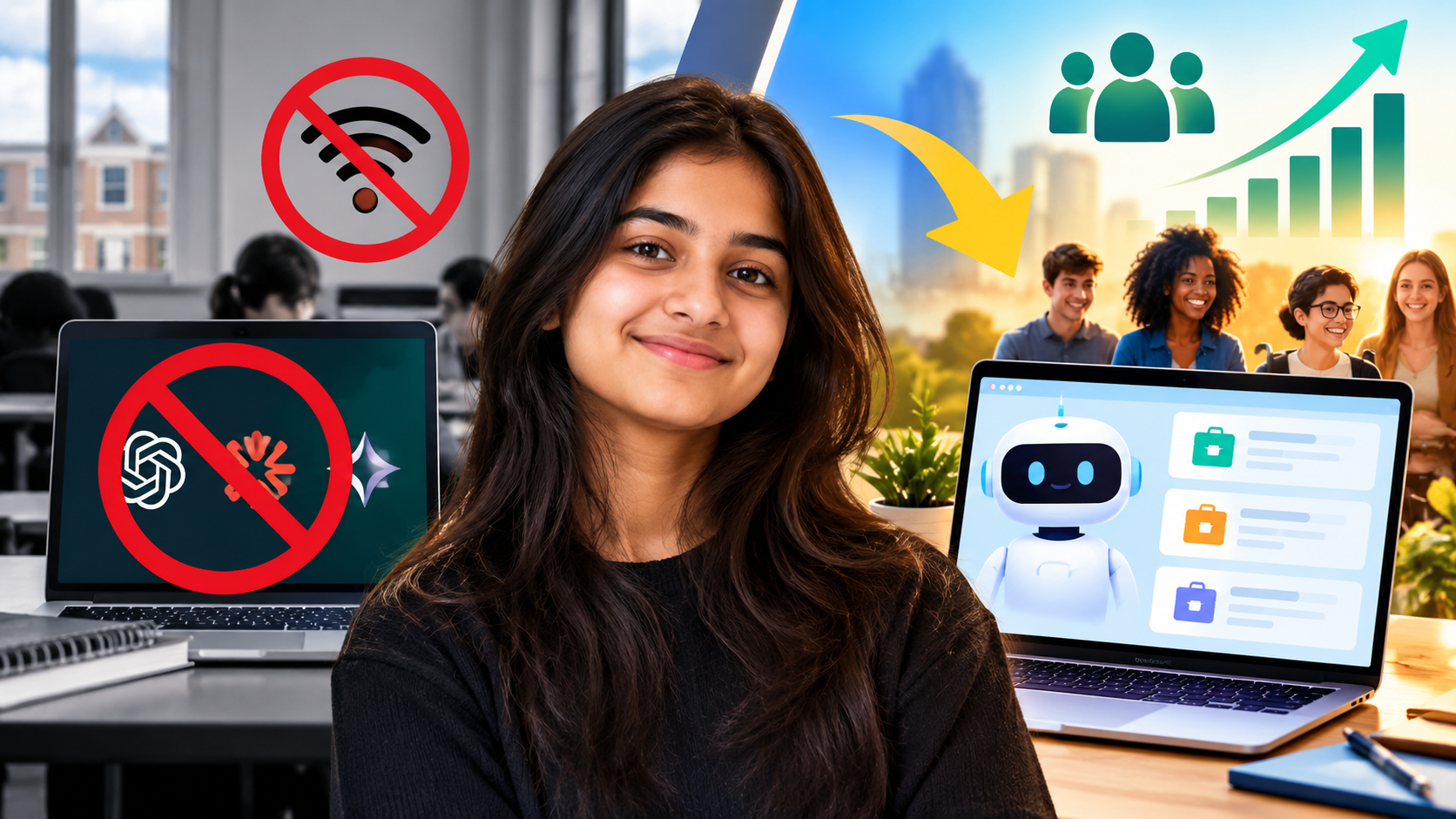
At 17, Navya Tuteja has already done something that many adults hope to do one day. She has built an AI startup with more than 1,000 users.
Her story began with something quite simple. Her school blocked ChatGPT, Claude and other AI tools from its WiFi. At first, this felt like a restriction. But over time, Tuteja says the rule also made her think more for herself.
Today, she is a senior at Thomas Jefferson High School for Science and Technology, a selective school outside Washington, D.C. She is also the founder of Raaha, a free AI platform for neurodivergent job seekers.
Two months after its launch, Raaha had more than 1,000 users and 20,000 job listings, according to Fortune.
Her story shows how a small problem can lead to a much bigger idea.
The idea behind Raaha
Raaha was not born only from a love of AI. A big part of the idea came from Tuteja’s family.
Her mother is hard of hearing. As Tuteja grew older, she saw how her mother’s disability could affect her work life. She noticed that the problem was not always easy for other people to see.
That made Tuteja think about people with disabilities that are not always visible.
She also noticed a problem with job ads. Most job posts focus on what an employer wants from a person. They list skills, duties and other requirements. But they often say very little about what the actual work life may feel like.
For a neurodivergent person, details such as work hours, communication style, remote work and schedule changes can matter a lot.
Raaha tries to make that part easier.
The platform checks a job post and gives a score based on several factors. This helps a person get a better idea of whether a job may suit them before they spend hours on an application. Technical.ly reported that Raaha looks at factors such as schedule predictability, communication style and remote work.
She built the startup herself
Tuteja did not wait for a large team or a big investment.
She bootstrapped Raaha herself and kept the platform free. Her plan is to build more traction first. In the future, she may have employers and workforce groups pay for access or for ways to improve their job listings.
This is one of the most striking parts of her story.
She is still in high school, yet she has already taken a real problem, built a product and put it in front of real users.
The early numbers also give a clear picture of the response. Raaha has more than 1,000 users and 20,000 job listings.
For a student-led project, those figures give the story a strong real-world side.
The school ban had an unexpected effect
The school rule around AI adds another layer to Tuteja’s story.
Her school blocks access to ChatGPT, Claude and similar tools. That meant she could not simply ask an AI system for help during the school day.
Tuteja says this made her use AI much less at school. She also believes the rule helped her keep a habit of doing her own academic work.
She does not say that AI itself is bad.
Instead, she has a more careful view. She believes people need to learn how to use AI properly.
That view is also clear in her own work. Tuteja wrote the main algorithm behind Raaha herself. She used AI for more basic tasks, such as parts of the website design. For school work, she says she prefers to learn on her own, especially for subjects that matter in exams.
So, the same student who leads an AI club at school also chooses not to use AI for her own schoolwork.
AI use among students is rising
Tuteja’s approach comes at a time when AI use among students is growing fast.
RAND research cited by Fortune found that the share of students who regularly used AI for homework rose from 48% to 62% between May and December 2025. Two-thirds of those students also said AI was hurting their critical thinking.
That creates a difficult question for schools.
Should schools block AI tools? Should they allow them? Or should they teach students how to use them in a safe and useful way?
Tuteja has an interesting answer because she has seen both sides herself.
She says she supports stronger AI rules, but she does not believe a full ban is the right answer.
Her view is that schools should focus on proper use and clear rules rather than simply cutting off access.
She also has another AI project
Raaha is not Tuteja’s only project.
She also created a tool called Legible. It helps families understand special-education documents such as IEPs and 504 plans.
These documents can be hard for many parents to understand. The problem can be even harder for families who are new to the American school system.
Tuteja noticed another issue here. When AI tools summarize disability information, they can sometimes remove the sources that parents need to check the information themselves.
That led her to work on a proposed transparency standard called Traceable Accessibility.
She has discussed the idea with local state senators and with the U.S. Department of Education as a possible resource.
Her parents have their own view
Tuteja’s parents also play a role in the story.
Her mother, Deepti Tuteja, works in data management oversight at TD Bank in the United States. Her father, Rohit Tuteja, works in cybersecurity governance, risk and compliance at Sentara Health.
Both have professional experience with technology and business.
But they have also tried to teach their daughter an important lesson: avoid shortcuts.
Her father has said that hard work matters and that cheating is not a path to success.
That idea seems to match the way Tuteja uses AI herself. She does not reject the technology. She chooses where it can help and where she wants to do the work herself.
A young founder with a clear purpose
Tuteja still plans to attend college. However, she has said that if Raaha continues to grow at its current pace, she may consider running the company full-time.
For now, her story is less about being a teenage founder and more about how she found a problem worth solving.
She saw a personal issue through her mother. She noticed a wider problem for neurodivergent job seekers. She built a tool to address it. Then she put that tool in front of real people.
The fact that her school blocked AI adds an unusual twist.
A rule that limited her access to AI did not stop her from building with it. Instead, she learned to use the technology on her own terms.
A lesson beyond AI
There is a simple lesson at the heart of Navya Tuteja’s story.
A startup does not always begin with a huge business plan. Sometimes it starts with a problem that feels close to home.
For Tuteja, that problem came from her family, school and her view of how people use technology.
Raaha now has more than 1,000 users and 20,000 job listings. That does not tell us where the company will go next, but it shows that her idea has already reached a real audience.
At 17, Tuteja is still a student. Yet she has already built a product, found users and started a wider conversation about AI, education and access to work.
Her story is a reminder that young people do not always need to wait for the perfect time to start. Sometimes, a problem right in front of them can be the first step toward a company.
ALSO READ: Startup World Cup New York: 12 Finalists Take Stage Today