
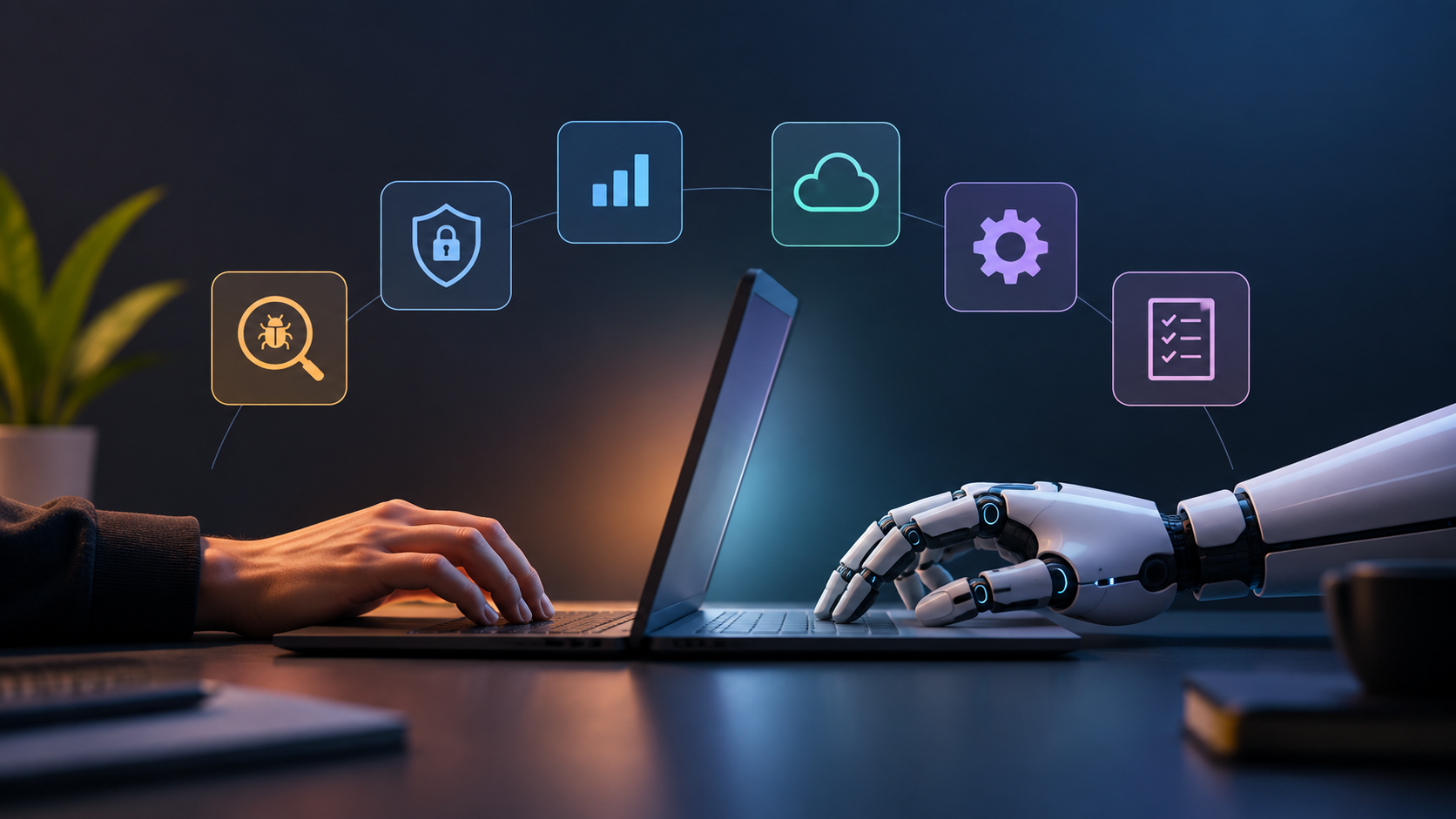
The developer tool market has entered a new phase. For years, many startups focused on one clear promise: help engineers write code faster. AI has changed that market. Code creation now takes far less time, and AI agents can handle tasks that once required hours of manual work.
That change creates a new business opportunity. The biggest need no longer sits only inside the code editor. The larger problem sits after code leaves the editor and reaches a real product.
AI can create code at remarkable speed. That code can still contain errors, security gaps, poor design choices, costly queries, weak tests, and hidden risks. A company may gain speed at the start and then lose that gain when a production system fails.
This creates a strong market for tools that can check, protect, test, control, and improve software made with AI.
The core question for a new developer tool startup now looks simple: what problem hurts enough for an engineer or a company to pay for a solution?
AI Code Verification Has Become a Major Need
AI has made software creation cheap. Trust in that software remains much harder.
JetBrains’ 2026 developer survey covered more than 15,000 professional developers. The survey found that 90% of developers use AI coding agents at least once each week, while 68% use them each day. Claude Code reached about 39% workplace adoption, up from 18% in January. Codex rose from 3% to 16%.
Those numbers show a major shift in developer habits. AI agents now sit inside normal software work rather than at the edge of it.
Yet faster code creation also creates a new risk. New Relic found that 94% of surveyed leaders gave high ratings to AI-generated code during review. At the same time, 78% reported more production incidents, while 86% reported more senior-engineer time for fixes related to AI-generated code. New Relic also found that 82% of respondents had faced at least one production failure tied to AI-generated code during the previous six months.
That gap creates a clear startup market.
A strong product could check an AI-created code change before it reaches production. Such a system could examine the code, run tests, compare past behavior, check security risks, study production data, and give a clear answer about release safety.
The strongest product would not act as another tool that adds comments to a pull request. It would answer a much more valuable question: can this software change safely reach real users?
CodeRabbit offers a strong market signal. The company raised $143 million at a $1.5 billion valuation in August. It now handles more than 2 million code reviews each week and has more than 17,000 customers.
The market has already shown that companies will pay for better code review and code trust.
Agent Security Creates a New Market
AI agents have far more access than older developer tools. An agent may hold API keys, call MCP servers, use plugins, access files, work with databases, browse the web, and call outside services.
That creates a new security problem.
A traditional software review may ask whether a package can access part of an application. An AI agent can have a much wider set of powers. The agent may call several tools, access company data, run code, and take action without a human check at every step.
AIR has already moved into this market. The company raised $50 million across two seed rounds. Its product helps enterprises find AI agents and check the skills, tools, plugins, and MCP components that those agents use.
That market could grow into a major security category.
A strong startup could give every AI agent a clear identity and a strict set of permissions. The system could record every action, check every tool, protect secrets, and stop an agent from reaching data outside its approved scope.
The idea has a simple value proposition: give AI agents only the access they need and keep a full record of what they do.
Enterprise security teams have a clear reason to pay for that control.
AI Agent Observability Has a Different Problem
Traditional software tools can answer questions such as why a service slowed down or why a request failed.
AI agents create a deeper problem. A single task may include many model calls, tool calls, database actions, API requests, and decision steps.
A company may need to know why an agent chose one action over another. It may need to find the tool call that caused a failure. It may also need to know why a simple task cost $17 instead of $0.20.
That creates room for a new form of observability.
Grafana Labs has passed $600 million in annual recurring revenue. Its CEO has linked a major part of its growth to AI deployment. Grafana now offers AI products that include agent observability, and its Assistant has more than 18,000 organizations as users.
Groundcover also raised $100 million in Series C funding, which brought its total funding to $160 million. Its core thesis focuses on the huge volume of telemetry that modern AI systems can create.
Tsuga raised $35 million in Series A funding with a similar focus on observability for the AI era.
The opportunity goes beyond another dashboard.
A strong product could trace a complete path from an AI agent to its model, tool, API, database, result, and next action. It could attach cost, speed, reliability, security, and business value to that full path.
That data could help an engineering team find the exact point where an agent fails or wastes money.
AI Cost Control Could Become a New FinOps Category
AI can create a cost problem that traditional cloud tools cannot fully solve.
Cloud infrastructure often follows fairly predictable usage patterns. AI agents can create far less predictable costs. A single task may call several models, use many tokens, access external tools, and repeat failed steps.
Anthropic and GitHub have moved toward metered and token-based AI pricing. That model gives companies more flexibility, but it also creates a new need for cost control.
A useful startup could act as a cost control layer for AI systems.
The product could route each task to a suitable model, select cheaper models when quality remains strong, cache repeat requests, stop runaway agents, set usage limits, forecast token costs, and find expensive tool calls.
The strongest feature could give a direct comparison between two choices.
For example, a system could show that a task costs $38 with the current setup but only $4.20 with another model and a better process, while the final result remains similar.
That creates a clear financial benefit. A tool that saves millions of dollars can command a large enterprise contract.
AI Creates a New Need for Better Software Tests
AI can create new features at high speed. A software team still needs confidence that those features work correctly.
A fast code process can create a large test gap. Old tests may miss new behavior. New code may introduce edge cases. Small changes can also break older features.
This creates demand for tools that create tests from real software behavior.
A strong system could study production traffic, find important user actions, create tests from those actions, run the tests against new code, and flag any change that alters expected behavior.
That approach has a major advantage over a simple AI test generator. The product does not rely only on source code. It can learn from what real users actually do.
The workflow becomes simple: production data creates tests, tests check new code, and the system opens a fix when a regression appears.
That can save senior engineers from large amounts of repetitive work.
Autonomous Software Maintenance Could Become Huge
AI has shown strong results with new code. Enterprise software contains another challenge: old code.
Many large companies rely on systems that are five, ten, or even twenty years old. Those systems contain old frameworks, outdated dependencies, complex integrations, undocumented rules, and technical debt.
AI has not rapidly removed established enterprise software from the market. A major reason comes from the nature of enterprise software work. Much of the work involves maintenance, integration, migration, and support rather than simple code creation.
That creates an attractive startup opportunity.
An AI maintenance engineer could study an old codebase, company tickets, logs, architecture, dependencies, and customer complaints. It could then find outdated packages, fix security issues, remove dead code, modernize old APIs, add missing tests, and prepare framework migrations.
This market has a major advantage. Companies already spend large amounts of money on maintenance.
A startup does not need to create a new budget category. It can replace part of an existing engineering expense.
Performance Optimization Can Become Autonomous
AI-generated code can work correctly and still waste resources.
A function may use too much CPU. A database query may cost too much. A service may consume excessive memory. A cloud system may spend money on resources that provide little value.
Dash0’s acquisition of Polar Signals offers a strong signal for this market. Polar Signals focuses on continuous profiling, which helps companies find areas where software consumes CPU, memory, and other resources. Dash0 plans to use that information for AI-driven tools that can identify inefficient code and create optimization pull requests.
This points toward an important product model.
Software could watch a live system, find waste, create a patch, run a benchmark, compare the result, and prepare a pull request.
A useful result might look like this: a service costs $82,000 each month, a proposed code change cuts the cost by 11%, and benchmark results show a 17% speed improvement.
That type of result gives an engineering leader a direct financial reason to buy the product.
Local AI Infrastructure Has Its Own Opportunity
The developer AI market does not depend only on large cloud models.
Ollama raised $65 million in Series B funding in July. The company had reached about 9 million users and 176,000 GitHub stars.
That growth shows strong demand for local AI tools and open models.
Nvidia’s planned $12.93 billion acquisition of Hugging Face also shows the strategic value of the open-model developer ecosystem.
This creates room for startups that make local and private AI easier to manage.
Enterprise teams may need private model deployment, local inference, GPU control, model routing, caching, and secure developer environments.
The opportunity does not require another model company. A stronger position may come from a software layer that lets developers work with many models through one reliable system.
The New Software Supply Chain
The old software supply chain had a simple structure. A developer selected a package, added dependencies, and shipped an application.
AI adds several new layers.
A developer may now use an agent. That agent may use a skill. The skill may call an MCP server. The server may call a tool. The tool may access an API or package.
Each layer can create a security risk.
AIR’s $50 million fundraise offers an early sign that investors see agent and tool security as a separate market.
A startup could focus on agent discovery, permissions, tool checks, provenance, audit records, runtime protection, or continuous security scans.
The best products may combine several of these functions into one control layer for autonomous software.
Where the Best Startup Opportunity Sits
The strongest opportunities share one feature: they solve an expensive problem.
AI code verification has very high willingness to pay, although competition already looks strong. Agent security also has very high value and less competition. AI agent observability has strong demand, while AI cost control has a direct link to company finances.
Autonomous software maintenance also stands out. It targets a huge amount of existing enterprise work rather than a new and uncertain market.
Generic AI coding assistants face a different situation. Demand remains high, but competition has become extreme. JetBrains data shows the rapid rise of tools such as Claude Code and Codex, while established AI coding products face strong pressure.
A startup therefore needs a sharper idea than “AI for developers.”
The Real Opportunity After AI Code Creation
The most valuable developer tools may not help engineers create more code.
They may help companies trust the code that AI already creates.
The new software stack needs a trust layer. That layer can check code quality, protect agents, trace agent actions, control AI costs, create tests, find performance waste, and maintain old systems.
Cognition raised $2 billion at a $48 billion valuation for autonomous software engineering. CodeRabbit reached a $1.5 billion valuation. AIR raised $50 million for agent and tool security. Observability companies have also raised large rounds around the needs of AI-era software.
These numbers show where the market is moving.
AI has reduced the cost of software creation. The next major developer tool market may focus on everything that follows.
The strongest startup thesis may therefore sit outside the code editor: software that proves AI-created code works, keeps it secure, controls its cost, protects production, and fixes problems when they appear.
That is a difficult problem. It is also a problem with a clear buyer, a measurable financial value, and a growing source of demand.
Also Read – AI Agent Startups: 10 Workflow Categories to Watch