
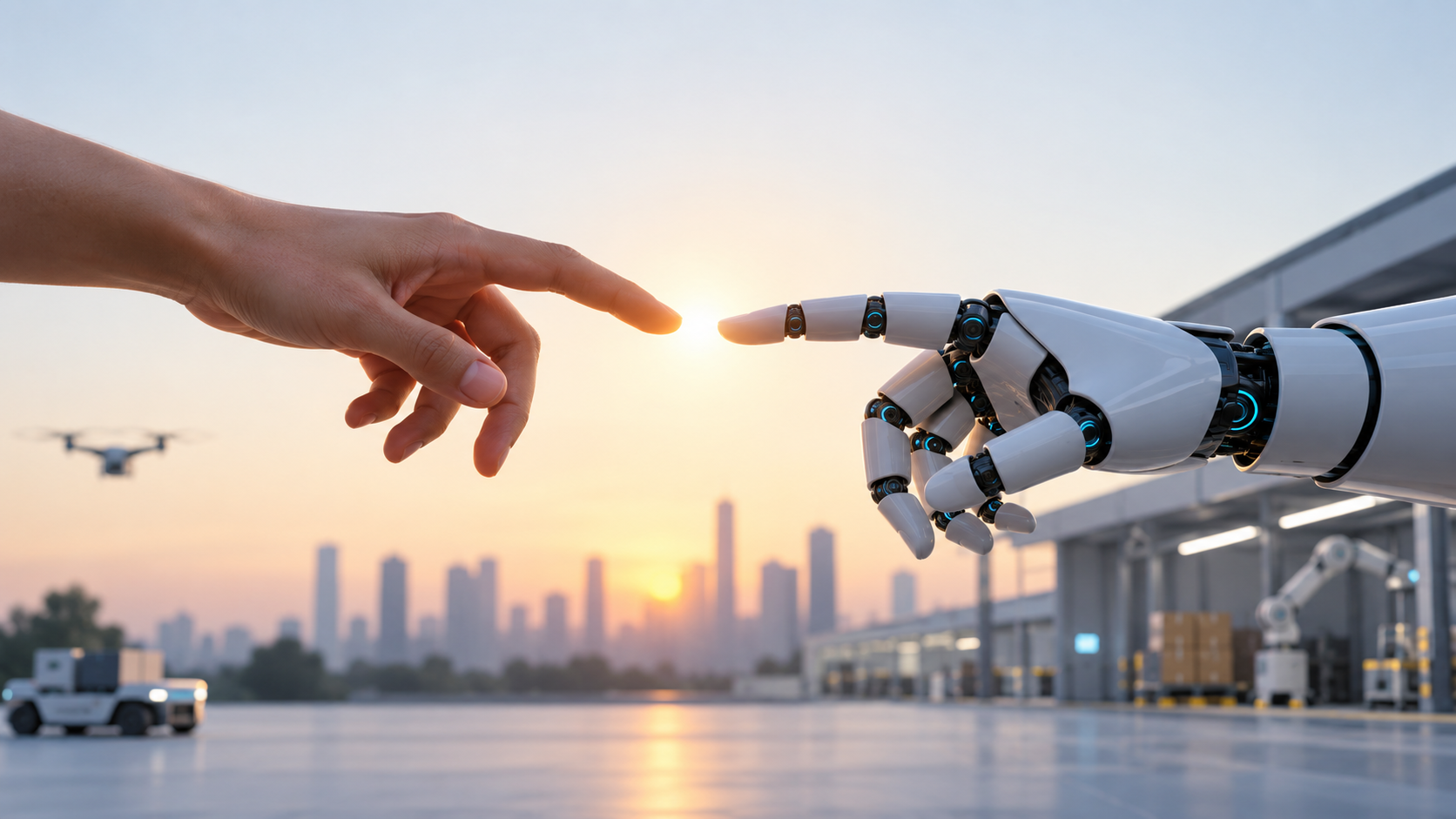
Robotics has entered a new phase. For decades, robots mostly followed fixed commands inside controlled spaces. A factory robot could lift a part, place it in a set position, and repeat that task thousands of times. The machine did not need to understand much about the world around it.
Artificial intelligence has changed that model. New robotics startups now aim to give machines a form of judgment. A robot can use cameras, sensors, software and AI models to see an object, understand its position, choose an action and carry out that action. This shift has created a fast-growing field called physical AI, or embodied AI.
The scale of investor interest shows how quickly the market has changed. Global robotics startups raised $18.8 billion in 2026 by June 22, according to Crunchbase. That amount already exceeded the $15 billion raised across the full year of 2025. It also passed the previous peak of $14.1 billion from 2021.
The wider physical AI market has grown even faster. Global venture funding for physical AI reached $47.4 billion across 521 deals in the first half of 2026. The figure stood at $12 billion across 470 deals in the second half of 2025. The first-half 2026 total also rose almost 80% from the $26.4 billion raised across 436 deals in the first half of 2025.
These figures show a major change in investor thinking. Robotics once looked like a costly hardware business with long development cycles. AI has changed that view. Investors now see a chance to create machines that can learn, adapt and handle a wider range of real-world jobs.
The Robot Is No Longer the Whole Product
The modern robotics market has many layers. Some startups build the physical robot. Others build the AI brain, sensors, software, training systems or data tools that make robots useful.
This difference matters. A company may never sell a humanoid robot and still hold a major role in the robotics market. A strong AI model could control many types of machines. A strong sensor system could help thousands of robots understand space and motion. A strong data platform could provide the material that future robot models need.
Skild AI offers a clear example. In January 2026, the company raised $1.4 billion in a Series C round led by SoftBank. The round pushed its valuation above $14 billion. Skild AI wants to build a single general-purpose brain that can control different robots and handle different tasks.
The idea has major value. A separate AI system for every robot creates high costs and slow development. A common intelligence layer could work across robot types and industries. Skild AI calls this approach “omni-bodied intelligence.”
Huge Money for Humanoid Robots
Humanoid robots receive much of the public attention. Their shape makes the idea easy to understand. A human-shaped machine could, in theory, use tools, move through buildings and handle work made for people.
Investment has surged in this area. Dealroom data shows $8.7 billion in venture investment for humanoid robotics startups in 2026 through July 22. That amount almost doubled the full-year record from 2025. China accounted for about two-thirds of humanoid robotics funding in 2026, while the US held a 15% share.
NEURA Robotics stands out among the largest deals. The German company announced a Series C round of up to $1.4 billion in June 2026. Qualcomm Technologies, Amazon, NVIDIA, Bosch, Schaeffler and other major investors backed the round. NEURA plans to use the capital to expand its Physical AI platform and target serial production at a scale of millions of robots by 2030.
Apptronik has also attracted major capital. The Austin-based company closed a $520 million Series A extension in February 2026. That round followed a $415 million Series A raised in 2025. Together, the two rounds took its Series A total above $935 million and its total capital close to $1 billion. Apptronik plans to scale production and deployment of its Apollo humanoid robot.
The size of these deals shows the ambition of the sector. Investors no longer treat humanoid robotics as a small research project. They see a possible new industrial platform.
Humanoids Still Face a Hard Test
Large funding numbers do not prove that humanoid robots can replace human workers at scale. The technology still faces serious limits.
A robot can perform a task in a controlled demonstration yet struggle in a real workplace. A human worker can pick up an object with an unexpected shape, change grip strength, move around another person and react to a sudden problem without a new program.
Robots still struggle with many of these simple human actions.
Recent tests in China show the contrast. Tiangong Ultra, a Chinese humanoid robot, ran 100 meters in 8.64 seconds and beat Usain Bolt’s 9.58-second world record. Yet the robot lacked key human abilities such as obstacle avoidance and quick decisions. It hit barriers after the race. The result showed that raw physical speed does not equal useful physical intelligence.
That gap matters for business. A factory does not need a robot that wins a race. It needs a machine that can work for hours, handle small changes, avoid people, recover from mistakes and complete tasks at a cost below the value of the work.
China Has Built a Powerful Robotics Position
China has become a central force in the robotics race. The country has large factories, deep supply chains, strong electronics production and a huge domestic market. These strengths can help robotics companies move from prototypes to mass production.
Dealroom estimates that China now takes about two-thirds of global humanoid robotics funding. Its share rose from about one-quarter in 2020. The US share has fallen to 15% in 2026.
Recent Reuters reports also show the scale of China’s commercial robotics sector. China accounted for about 95% of global humanoid shipments in 2025, according to a Reuters report from September 2026. Chinese companies now hold a major position in both humanoids and quadruped robots.
Unitree has become one of the best-known examples. The company has sold tens of thousands of robots and has reached a reported valuation of $9 billion. Its products include robot dogs and humanoids.
China has also placed embodied AI and robotics inside its broader industrial strategy. A five-year plan announced in September 2026 targets small and medium-sized technology companies and names robotics and embodied AI among its strategic sectors. The plan aims to raise the number of specialized “little giant” companies to 22,000 by 2030.
This support gives Chinese robotics companies access to a large industrial base and a large market for real-world tests.
The Real Bottleneck Is Data
Hardware gets most of the attention, yet data may matter more.
A language model can learn from enormous volumes of text. A robot cannot learn physical work from text alone. It needs examples of movement, touch, force, position, balance and interaction with objects.
That creates a difficult problem. High-quality physical data takes time and money to collect. Each useful example may require a robot, sensors, a human operator, a real workplace and a safe method for recording the action.
Several startups now focus on this part of the market.
Generalist, for example, has pursued a model based on physical interaction data. The company has reported more than 500,000 hours of training data. Its approach aims to give robots more information about how objects and machines behave in real environments.
Avatar Robotics has taken another route. Its model uses remote human control of robots in industrial settings. A person can guide the robot through real work while the system records the actions. Each job can then add more useful data to the company’s AI system.
This creates a powerful cycle. More robot work creates more data. Better data can create better AI. Better AI can reduce the need for human control. Lower human involvement can improve the economics of robot use.
Specialized Robots May Beat Humanoids
The humanoid form has a clear advantage: humans already design workplaces around the human body. Yet a human shape does not always offer the best machine design.
A warehouse task may need a robotic arm, wheels and a strong lifting system. A mine may need a tracked vehicle. A farm may need a machine designed around crops. A delivery service may need a drone.
Dexterity shows this alternative path. The company focuses on industrial automation, with systems designed for tasks such as truck loading and pallet work. Such machines do not need to copy the human body. They need to perform a specific job well.
This approach could produce faster commercial results. A specialized robot can focus its hardware and software on one clear task. A humanoid robot must solve a much larger set of problems.
That does not make humanoids less important. It simply shows that physical AI has many possible forms.
The Factory May Become the First Major Market
Factories offer one of the clearest paths for robotics startups. The work often has repeatable steps, clear goals and measurable costs.
Logistics also offers strong potential. Robots can sort goods, move boxes, load pallets and handle repetitive warehouse tasks.
Dangerous work offers another strong market. Mining, energy, inspection and other high-risk sectors can gain value from machines that keep people away from unsafe areas.
Construction presents a much harder challenge. Every site has a different layout, changing materials and unpredictable conditions. A robot must understand a less controlled environment.
The home represents an even larger prize, yet it may take longer. A factory can change its layout around a robot. A home contains stairs, furniture, pets, children, fragile objects and thousands of small variations. A household robot must deal with all of them.
The Next Test Is Simple: Real Economic Value
The robotics market now has huge capital, major technology companies and hundreds of ambitious startups. The next phase will test whether those companies can turn technical progress into real business value.
A robot does not need perfect human intelligence. It needs reliable performance at a reasonable cost.
That means the most important measures may not come from a trade-show demonstration. They may come from the number of hours a robot can work without help, the number of human interventions it needs, the cost per completed task and the amount of revenue a customer gains from deployment.
Robot use also needs high machine utilization. A costly robot that works for two hours each day may struggle to justify its price. A robot that can work for most of the day and handle many tasks has a much stronger business case.
The same test applies to AI models. A model that controls one robot in one factory has limited value. A model that can control different machines across different workplaces has far greater potential.
A New Computing Layer for the Physical World
The strongest robotics startups may eventually look less like traditional hardware companies and more like AI platforms.
The basic cycle is simple. A robot collects real-world information. An AI model uses that information to choose an action. The robot carries out the action. The result creates new data. That data can help improve the next decision.
This cycle could create a new form of computing for the physical world.
Software once changed office work through computers and the internet. AI has now changed how software handles language, images and knowledge. Robotics could extend that change into factories, warehouses, hospitals, farms, construction sites and homes.
The biggest question now concerns scale. Can robots move from impressive demonstrations to dependable workers?
The answer will shape the next stage of the AI market.
The money already shows strong belief in the opportunity. Robotics startups have raised $18.8 billion in 2026 by June, while physical AI companies raised $47.4 billion across 521 deals in the first half of the year. Humanoid startups alone reached $8.7 billion in venture investment through July 22.
Those numbers mark a major shift. AI no longer sits only inside computers and cloud servers. A growing group of startups now aims to place AI inside machines that move, see, touch and work in the real world.
The winners may not come from the companies with the most human-like robots. The strongest businesses may come from the teams that solve the hardest practical problems: reliable AI, useful data, low-cost hardware, safe autonomy and strong customer economics.
That is where the robotics story becomes much larger than humanoids. It becomes a race to give machines the ability to understand physical work and perform it well.
Also Read – Startup IPO Readiness: Metrics That Public Markets Watch