
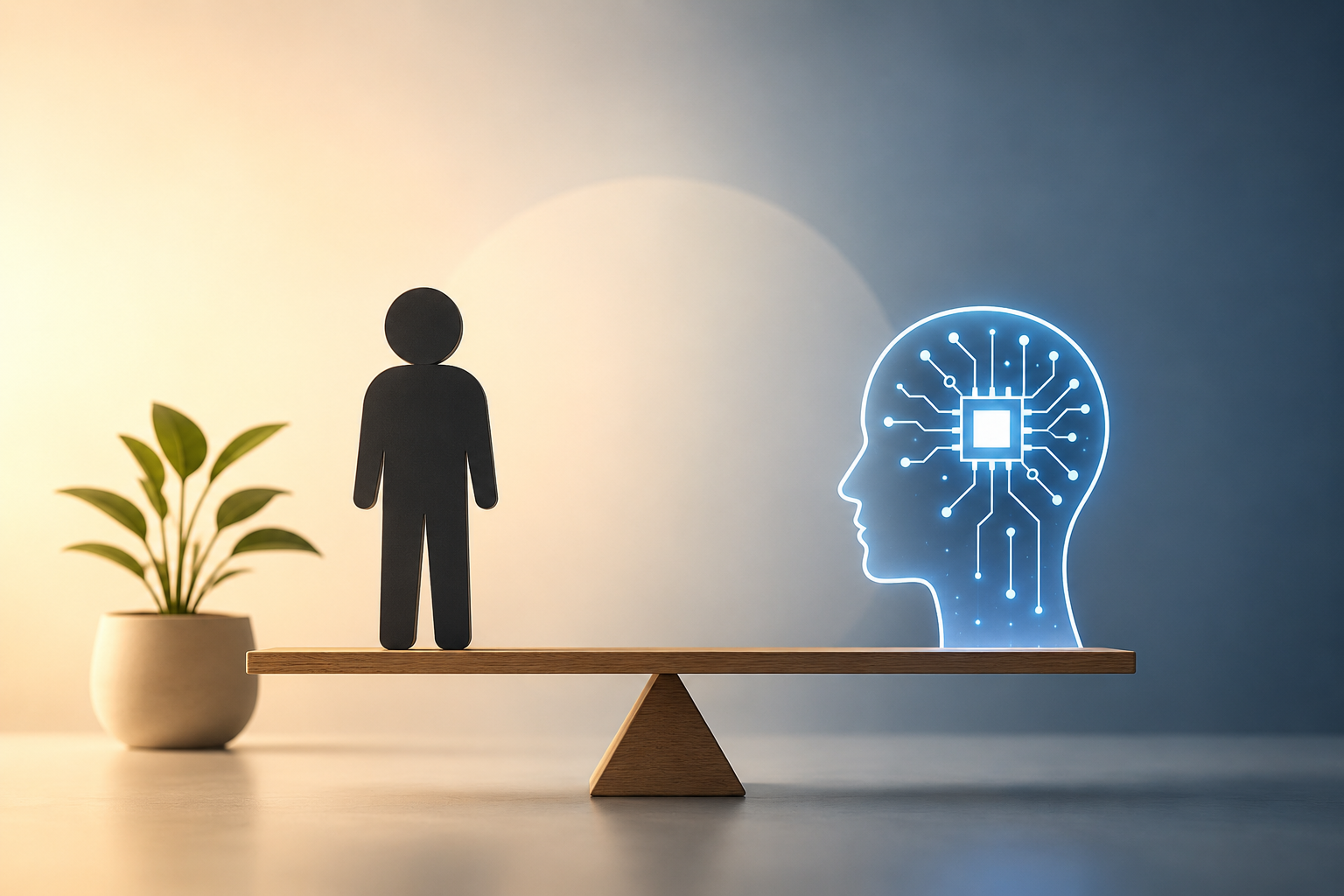
Artificial Intelligence has become the biggest business trend of this decade. Every day, new companies launch products that promise faster work, lower costs, and less dependence on employees. Across the startup world, one idea has started to spread very fast. Many founders now ask a serious question. If AI can do human work, why keep large teams at all?
This idea sounds exciting at first. AI works all day without sleep. It answers customers in seconds. It writes code, creates reports, analyzes data, and even handles customer support. For many startups that struggle with money, the dream looks simple. Replace expensive human workers with software and save huge amounts of cash.
But this idea has a dangerous side.
Many founders focus only on what AI saves today. Very few think about what this decision may cost in the future. The truth is simple. Replacing humans with AI may create serious long-term damage that many companies fail to notice until it becomes too late.
The smarter path may not be replacing people. The smarter path may be helping people work better with AI.
This debate has become one of the most important business questions in modern technology.
Why Startups Want AI to Replace Workers
The startup world moves very fast. Founders often work under pressure. Investors want rapid growth. Competition grows stronger every year. In this environment, every company looks for ways to move faster while spending less money.
AI looks like the perfect answer.
For a startup, employee salaries usually become the biggest expense. Hiring engineers, designers, marketers, customer support teams, and managers costs a lot of money. If software can do part of this work, founders believe they can reduce costs immediately.
Another reason comes from speed. AI completes many tasks within seconds. A chatbot answers customer questions faster than a human support worker. AI code assistants help developers write software much faster than before.
Investor pressure also plays a major role. Many investors now want companies to become “AI-first.” Some founders feel forced to show strong AI adoption because they fear competitors may move ahead.
Companies such as Meta have invested heavily in AI systems that perform economically valuable tasks. New startups such as Artisan AI even became famous after promoting the idea that companies should stop hiring humans and trust automation instead.
This trend has created a new business culture where many founders believe fewer employees automatically means a stronger company.
But reality often looks very different.
The Quality Problem Appears Slowly
One major danger comes from quality loss.
AI performs very well when work follows clear rules. It can answer common customer questions, summarize documents, and write basic code quickly.
But startups often face situations that have no clear answer.
Real business problems require judgment, creativity, intuition, and experience. Humans understand context in ways machines still cannot fully match.
Many companies notice this problem only after major damage appears.
A strong example came from Ford Motor Company. Reports showed the company replaced hundreds of engineers with AI systems. Later, quality problems started to appear, and the company had to bring human workers back.
This shows an important truth.
A company may save salary costs today, but product quality may slowly decline over time.
This hidden damage usually stays invisible at first.
The Expensive Cleanup Problem
AI creates work very fast.
This speed often creates another hidden issue.
In software development, AI code tools can write thousands of lines within minutes. At first, this looks amazing. A startup may feel it has become far more productive.
But fast work does not always mean good work.
AI often writes code with poor structure. It may create security weaknesses. It may repeat unnecessary code. It may ignore long-term system design.
Later, developers must spend months fixing these mistakes.
This hidden cost has started to appear in many startups.
Business Insider recently reported that startups which depend heavily on AI code generation already face major technical debt. Teams now spend large amounts of time fixing AI-created problems.
The lesson here feels simple.
A company may move fast at the start but pay a much larger cost later.
Companies Lose Valuable Human Knowledge
Every company depends on knowledge that does not exist in documents.
Employees understand customers in ways software cannot fully copy.
A support worker may notice patterns in customer frustration. A salesperson may understand emotional reactions during negotiation. A developer may know hidden technical details that never enter official records.
This type of knowledge grows over years.
When companies remove workers too quickly, this knowledge disappears.
AI cannot replace years of lived experience inside a business.
This creates a dangerous weakness.
The company loses its memory.
A startup may believe software can replace workers, but software cannot replace deep understanding built through real human experience.
Innovation Starts to Slow Down
AI has become very powerful, but people often misunderstand how it works.
AI studies patterns from existing data. It looks at information humans already created. Then it predicts the most likely next answer.
Humans think differently.
People imagine new ideas that never existed before. Great startups usually succeed because founders create something unusual.
Innovation depends on originality.
When companies reduce human involvement too much, original thinking often becomes weaker.
A team full of creative people can challenge ideas, debate solutions, and create something new.
AI usually improves existing patterns. It rarely creates true breakthroughs on its own.
NVIDIA CEO Jensen Huang recently said companies should use AI to increase output rather than reduce jobs.
This idea reflects an important truth.
AI helps execution.
Humans create vision.
Employees Lose Trust in Leadership
Companies rarely discuss emotional damage after AI replacement.
When workers watch coworkers lose jobs because software takes over, fear spreads quickly.
Employees begin to ask difficult questions.
Will I lose my job next month?
Will management replace me after better AI arrives?
Should I stay loyal to this company?
This uncertainty hurts morale.
The strongest workers often leave first because they have better opportunities elsewhere.
The company then loses valuable talent.
This problem does not show inside spreadsheets.
Revenue numbers may look stable for months.
But inside the company, trust begins to collapse.
Once employee trust disappears, company culture becomes very hard to repair.
AI Failure Can Break Entire Operations
Another hidden danger comes from overdependence.
Some startups automate too much too fast.
This creates a fragile business structure.
If AI makes one major mistake, entire operations may fail.
AI systems sometimes produce false information. Experts call these hallucinations.
A customer service AI may give incorrect advice. An automated financial system may process wrong data. AI security tools may miss dangerous threats.
When humans remain involved, mistakes often get caught early.
When humans disappear, errors spread faster.
A study connected to MIT found that only around five percent of enterprise AI projects created measurable value.
This number shows how difficult real-world AI adoption can become.
Too much automation may create serious operational weakness.
Competitors Can Easily Copy AI Businesses
Many startup founders believe AI gives them an advantage.
But there is another side to this argument.
If a company depends entirely on AI tools available to everyone, what makes that company unique?
Many modern startups simply build products around large AI models.
This means competitors can often create nearly identical services very quickly.
When technology becomes easy to copy, companies lose their competitive advantage.
This problem creates what business experts call commoditization.
In simple terms, companies start to look the same.
If every startup uses identical AI systems, customers have little reason to stay loyal.
The company loses its moat.
Technology alone rarely creates lasting success.
Customers Still Prefer Humans More Than Founders Expect
Many founders believe customers will happily accept AI in every situation.
Reality tells a different story.
People accept automation for simple tasks.
Customers may use AI for scheduling, basic questions, order tracking, or simple account support.
But trust becomes very important in more serious situations.
Healthcare decisions require human judgment.
Business negotiations require emotional intelligence.
Consulting depends on understanding complex needs.
High-value sales depend on relationships.
People often want human reassurance when decisions feel important.
Even if AI gives correct answers, customers may still prefer human interaction.
Joseph Weizenbaum, an early computer scientist who studied artificial intelligence ethics, warned that replacing humans in empathy-driven work could reduce human dignity.
This concern has become more important today.
Technology may solve problems, but trust still belongs to people.
Investor Pressure Creates Bad Decisions
Startup founders often face pressure from investors.
Investors want growth, efficiency, and strong future potential.
Today, many investors view AI as the future of business.
This creates dangerous incentives.
Some founders begin to focus more on appearances than reality.
A company may announce large staff reductions after AI adoption.
Investors may see this as efficiency.
Lower payroll creates attractive financial numbers.
But these decisions may hurt the company’s long-term future.
Instead of building strong products, founders start chasing market hype.
History shows this pattern before.
During the dot-com era, many companies chased internet hype instead of building sustainable businesses.
Many failed.
The same risk now exists with AI.
Short-term excitement can create long-term damage.
Society Will Push Back Eventually
Mass replacement of workers may create broader social problems.
If enough companies replace people with AI, unemployment could rise sharply.
Governments may react through new regulation.
Labor groups may protest against aggressive automation.
Public opinion may shift against companies that remove large numbers of jobs.
Goldman Sachs research estimated AI could affect a huge amount of work across the global economy.
New jobs may appear later, but disruption could become severe before balance returns.
This creates political risk.
Companies that depend too heavily on automation may face future legal restrictions.
Many governments have already started close observation of AI development.
This issue may become far bigger over the next decade.
The Skill Problem Nobody Discusses
One hidden consequence receives very little attention.
Skill loss.
Young workers learn through difficult work.
Junior developers become senior engineers after years of solving hard technical problems.
Young marketers learn strategy after handling real campaigns.
Sales professionals improve after difficult customer conversations.
If AI starts doing all difficult work, young workers stop learning.
Future experts never develop.
This may create a serious long-term economic problem.
For example, if junior programmers rely entirely on AI code assistants, they may never learn deep debugging skills.
Without strong juniors today, companies lose strong seniors tomorrow.
Bill Gates recently said AI may replace many jobs, but humans will still decide what society values most.
This idea matters deeply.
Technology should support skill growth, not destroy it.
The Better Approach for Startups
The smartest companies do not ask how to remove humans.
They ask how to make humans more effective.
This difference changes everything.
AI works extremely well for repetitive tasks.
It can handle data entry, report creation, ticket classification, scheduling, and simple administrative work.
Humans should focus on areas where judgment matters most.
Product strategy requires deep thinking.
Hiring decisions require emotional understanding.
Sales negotiations depend on trust.
Leadership demands vision.
Creative direction requires originality.
The best companies combine both strengths.
AI handles repetitive work.
Humans focus on high-value decisions.
This creates stronger long-term businesses.
Final Thoughts
The startup world currently stands at an important turning point.
Many founders believe success means replacing workers with AI.
This idea sounds efficient, modern, and profitable.
But the hidden consequences tell a different story.
Quality problems can appear slowly.
Technical debt may grow quietly.
Valuable human knowledge may disappear.
Innovation may weaken.
Employee trust may collapse.
Operations may become fragile.
Competitors may easily copy AI-based businesses.
Customers may still prefer real human contact.
Investor pressure may push founders toward dangerous short-term decisions.
Future workers may never develop important skills.
The companies that win in the future will not be those that replace eighty percent of employees with machines.
The real winners will build systems where every employee becomes far more productive with AI support.
The dangerous question is simple.
How do we remove humans?
The smarter question is far more important.
Where does human judgment create value that technology can never fully replace?
That answer may define the future of every startup in the AI era.
Also Read – How Brand Placement in Movies Helps Startups Grow Fast