
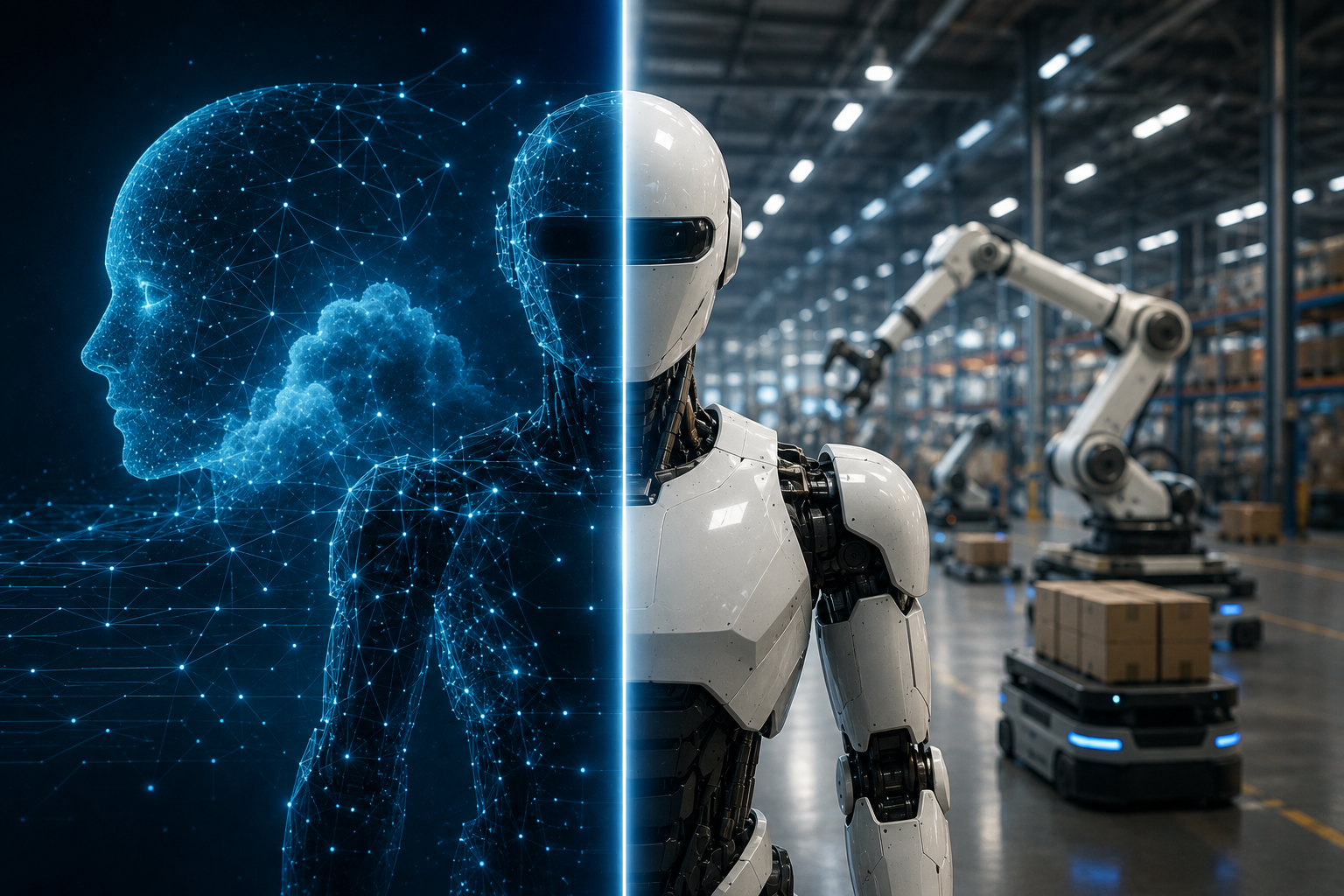
For the last few years, the world stayed focused on artificial intelligence tools like ChatGPT. These systems changed the way people write, search online, create content, and even code software. Because of this, investors rushed toward companies that built chatbots and generative AI products. Billions of dollars entered the sector very quickly.
But a major shift has now started. Investors no longer focus only on AI that can talk or write. A huge amount of money has quietly started moving toward a new area called embodied AI. Many experts believe this could become even bigger than ChatGPT over the next decade.
The reason is simple. ChatGPT can answer questions, but embodied AI can interact with the physical world. That opens the door to much larger industries and much bigger profits.
What Exactly Is Embodied AI
Embodied AI simply means artificial intelligence that exists inside physical machines. Unlike software tools that only give digital answers, embodied AI allows machines to understand their surroundings and take action in the real world.
A robot with embodied AI can look at objects, understand spoken instructions, decide what action makes sense, and then physically complete a task. Instead of only telling someone how to make coffee, the machine can actually pick up a cup, press the coffee machine button, and pour the drink.
This technology powers humanoid robots, self-driving delivery machines, warehouse automation systems, factory robots, drones, healthcare machines, and home assistants. In short, this is AI that does real physical work.
Investors Have Started Losing Interest In Chatbot Markets
Generative AI exploded after ChatGPT became popular. Since then, thousands of companies have entered the same space. New startups continue to launch AI writing tools, coding assistants, customer support bots, and search products almost every week.
This created a major problem for investors. Competition has become extremely crowded. Many companies now offer similar products and it becomes harder to stand out.
Open-source AI models from companies like OpenAI, Google, Meta, and Anthropic continue to improve fast. As AI models become easier and cheaper to access, profit margins begin to shrink. Investors now search for the next big opportunity that competitors cannot easily copy.
Physical Labor Is A Much Bigger Market
One major reason money has started flowing into embodied AI is the size of the market itself.
Chatbots mostly target knowledge work. They help writers, coders, marketers, researchers, and office workers. But embodied AI targets physical labor, which covers a much larger part of the global economy.
Robots powered by embodied AI could eventually handle factory work, warehouse operations, package delivery, security patrols, construction tasks, elderly care, farming, and industrial manufacturing.
Experts estimate global physical labor represents more than 30 trillion dollars in economic activity. This makes the opportunity far bigger than software-based AI products.
Global Worker Shortages Create Huge Demand
Another important reason behind this investment wave is labor shortage. Several major economies now struggle to find enough workers.
Countries like Japan, the United States, Germany, and China face serious population challenges. Birth rates continue to fall while older populations continue to grow. Businesses increasingly face difficulty finding workers for factories, logistics centers, warehouses, and care services.
Embodied AI offers a long-term solution. Robots can eventually take over repetitive physical tasks where worker shortages continue to grow year after year.
Hardware Costs Have Fallen Dramatically
A decade ago robotics development required huge spending. Advanced sensors, cameras, processors, and computing systems cost too much for many companies.
Today the situation looks very different. Prices for cameras, sensors, LiDAR systems, AI chips, and advanced processors have dropped significantly. Better hardware now makes robotics development cheaper and more practical.
Large technology companies such as NVIDIA, Qualcomm, and Intel helped push this trend forward by producing better hardware at lower costs.
AI Models Have Become Smart Enough
Earlier robots followed fixed instructions and could only perform very specific tasks. Modern AI models changed that completely.
Today advanced systems combine language understanding, computer vision, memory, reasoning, and planning. This led to the rise of something called Vision Language Action models, often called VLA models.
These systems allow machines to see their environment, understand human instructions, make decisions, and complete physical actions. This breakthrough pushed embodied AI much closer to real-world commercial use.
Massive Investment Is Already Happening
One of the biggest examples is Skild AI, one of the fastest-growing embodied AI companies in the world.
The company raised 300 million dollars in 2024. In 2025, another 500 million dollars entered the company. By January 2026, Skild AI secured 1.4 billion dollars in fresh funding.
Its valuation now stands above 14 billion dollars. Investors include SoftBank, NVIDIA, Jeff Bezos, and Sequoia Capital.
Another company called Prometheus recently raised an enormous 12 billion dollar Series B round, pushing valuation close to 41 billion dollars. The company focuses on industrial design systems, jet engines, and medical manufacturing technology. Investors include JPMorgan, BlackRock, and Goldman Sachs.
China Has Started Moving Aggressively
China has also entered the embodied AI race at full speed.
In the first two months of 2026 alone, more than 30 financing rounds took place inside China’s robotics and embodied AI sector. During this short period, startups raised nearly 20 billion yuan.
China now has around 10 unicorn startups in this sector. Major names include Spirit AI, EngineAI, and Galaxea AI.
This shows that global competition in physical AI technology has already become intense.
Venture Capital Has Changed Direction
Just two years ago, investors mainly searched for chatbot startups. The popular investment strategy looked very simple. Build an AI software company and raise capital fast.
That mindset has now changed. Investors increasingly focus on companies that can build the intelligence layer behind robots and physical automation systems.
They want companies that control robot brains, industrial automation software, autonomous logistics systems, robotics operating systems, and real-world data networks.
This explains why robotics venture funding jumped from 4 billion dollars in 2019 to nearly 26 billion dollars in 2025.
Why Experts Believe This Could Become Bigger Than ChatGPT
ChatGPT and similar tools transformed digital work, but embodied AI targets something much larger.
The future may involve robots inside factories, warehouses, hospitals, farms, homes, and delivery systems worldwide. If machines eventually replace even part of human physical labor, the market could become far larger than the generative AI boom we see today.
The next technology race may no longer focus on AI that simply talks to humans. The real future may belong to machines that can think, understand the physical world, and take action independently.
This is exactly why investors have quietly started pouring billions into embodied AI. The market is now shifting from AI that speaks to AI that acts, and many believe this could define the next trillion-dollar technology revolution.
Also Read – 10 Tax Free Countries for Indians to Launch Startups Fast