
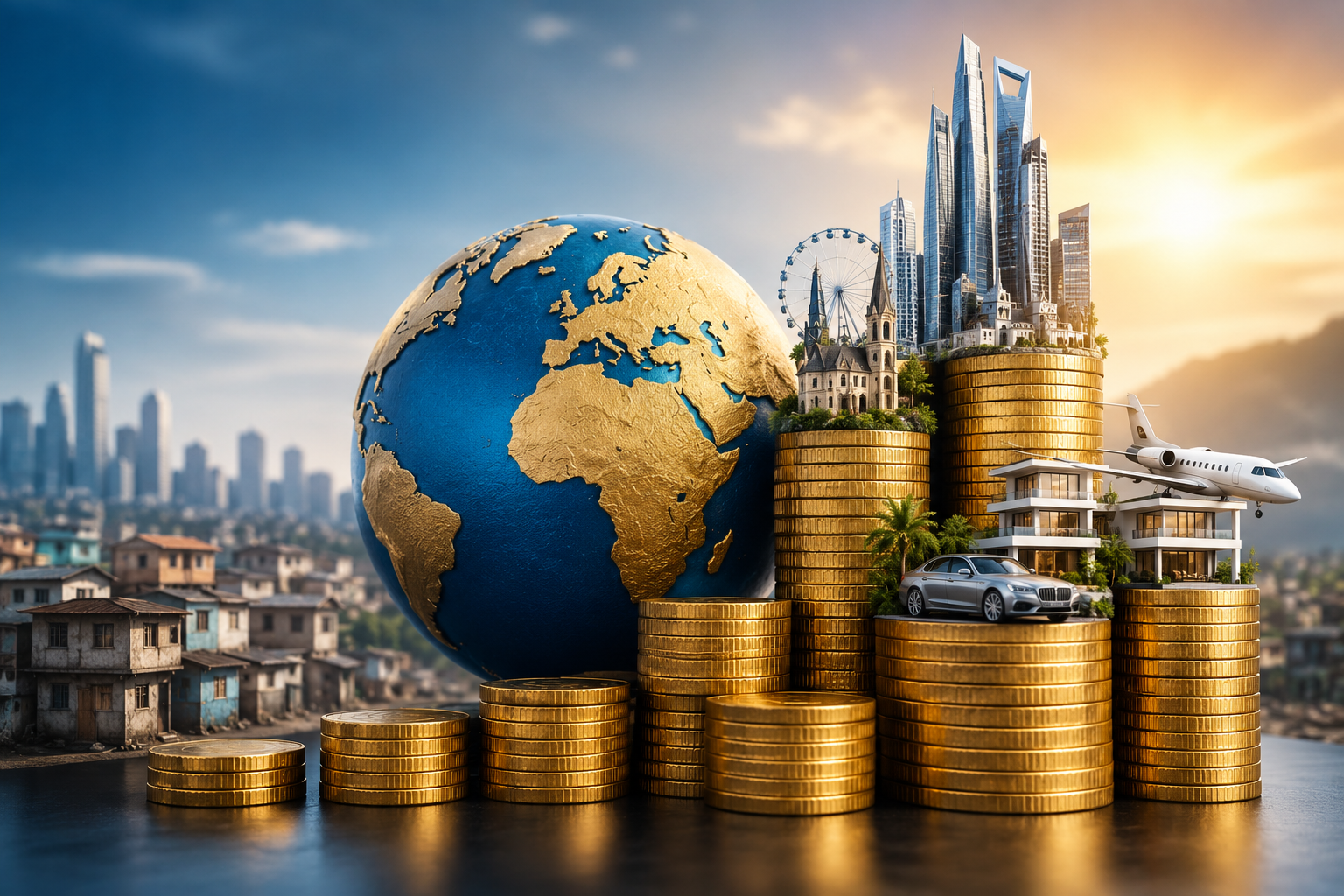
When people think about the richest countries in the world, names like the United States, China, Germany, or Japan usually come first. Most people believe countries with huge economies must also be the richest places on earth.
But the truth in 2026 tells a very different story.
The richest countries in the world are not always the biggest economies. In fact, several small nations now hold the top positions. This surprises many people because the way wealth gets measured often creates confusion.
To understand this clearly, it is important to know how experts calculate a country’s wealth.
What Does Richest Country Really Mean?
Many people judge wealth by the total size of a country’s economy. Economists call this Gross Domestic Product, or GDP.
GDP shows the total value of goods and services a country produces in one year. By this method, countries like the United States and China remain the world’s biggest economies.
But this number does not always show how wealthy people in that country really are.
Another method, called GDP per capita, gives a better picture. This number divides the country’s total economic output by its total population.
This helps experts estimate average wealth for each person.
This is the reason the richest country list often surprises people.
Richest Countries in 2026
The richest countries in 2026 look very different from what most people imagine.
Here is the latest ranking based on GDP per capita.
| Rank | Country | Estimated GDP Per Capita |
|---|---|---|
| 1 | Liechtenstein | $226,800 |
| 2 | Luxembourg | $158,700 |
| 3 | Ireland | $140,200 |
| 4 | Switzerland | $126,200 |
| 5 | Iceland | $110,000 |
| 6 | Singapore | $107,800 |
| 7 | Norway | $105,900 |
| 8 | United States | $94,400 |
| 9 | Denmark | $83,400 |
| 10 | Qatar | $75,000+ |
This list clearly shows that small countries now dominate global wealth rankings.
Why Small Countries Reach the Top
Many people wonder why small countries rank much higher than powerful nations.
The answer is simple.
Most of these countries have very small populations. Even if their economies are smaller than major countries, the total wealth gets divided among fewer people.
This causes GDP per capita to rise sharply.
A country with fewer citizens can appear richer than countries with millions of people, even if the total economy remains much smaller.
This is one major reason why large countries often stay lower on the list.
Why Luxembourg Remains So Wealthy
Luxembourg has remained one of the richest countries for years.
The country has a very strong banking sector and a powerful financial industry. Many global businesses place investments there because tax policies favor companies.
Luxembourg also has a population of only around 700,000 people.
Because of this, average wealth per person stays extremely high.
Over time, Luxembourg has become one of Europe’s strongest financial centers.
Singapore’s Economic Success Story
Singapore often surprises people because of its small size.
Despite limited land, Singapore has built one of the strongest economies in Asia.
Its location makes it one of the world’s most important trade centers. Ships and goods from many countries pass through Singapore every day.
The country also has a strong technology sector and an excellent financial system.
Business laws remain favorable, which attracts major international companies.
These factors help Singapore stay among the richest nations in 2026.
Ireland’s Rapid Rise
Ireland now ranks among the richest countries because many major companies use it as their European headquarters.
Large technology firms such as Apple, Google, and Meta operate there.
One important reason is Ireland’s corporate tax system.
Many multinational companies report profits through Ireland, which pushes GDP numbers much higher.
This helps Ireland stay near the top of global wealth rankings.
Why Liechtenstein Holds First Place
Liechtenstein now holds the number one position in 2026.
It is one of the smallest countries in Europe with fewer than 40,000 people.
The country has a strong private banking sector and high-value manufacturing businesses.
Because the economy serves such a small population, GDP per capita reaches extraordinary levels.
This explains why Liechtenstein ranks above every other country.
Largest Economies Look Very Different
If wealth gets measured by total GDP instead of GDP per capita, the ranking changes completely.
The countries with the biggest economies in 2026 are listed below.
| Rank | Country | Total GDP |
| 1 | United States | $32.4 Trillion |
| 2 | China | $20.9 Trillion |
| 3 | Germany | $5.45 Trillion |
| 4 | Japan | $4.38 Trillion |
| 5 | India | $4.15 Trillion |
This comparison shows a very important difference.
A country can have one of the biggest economies in the world but still not rank among the richest countries per person.
GDP Per Capita Does Not Show Everything
Even though GDP per capita helps measure average wealth, it does not always tell the complete story.
Some countries show unusually high numbers because international companies move profits there for tax benefits.
Countries like Ireland, Luxembourg, Bermuda, and the Cayman Islands often benefit from this.
This can make economic numbers look larger than everyday reality.
Because of this, economists study other measurements as well.
Purchasing Power Parity, also called PPP, compares how much people can actually buy in each country.
Median household wealth also helps experts understand how money spreads among ordinary families.
These methods often give a more realistic picture.
Final Thoughts
The biggest lesson from the 2026 rankings is very clear.
The richest countries are not always the largest countries.
Massive economies like the United States, China, and India lead global production, but smaller nations often create much higher wealth for each citizen.
Countries like Liechtenstein, Luxembourg, Singapore, and Switzerland prove that smart economic planning can create extraordinary success.
At Perfect Finserv, understanding these global financial patterns helps businesses and investors make smarter long-term decisions.
The 2026 rankings remind us that economic strength is not always about size.
Sometimes the world’s richest places are the countries people least expect.
Also Read – AI Chatbots and the Hidden Water Crisis