
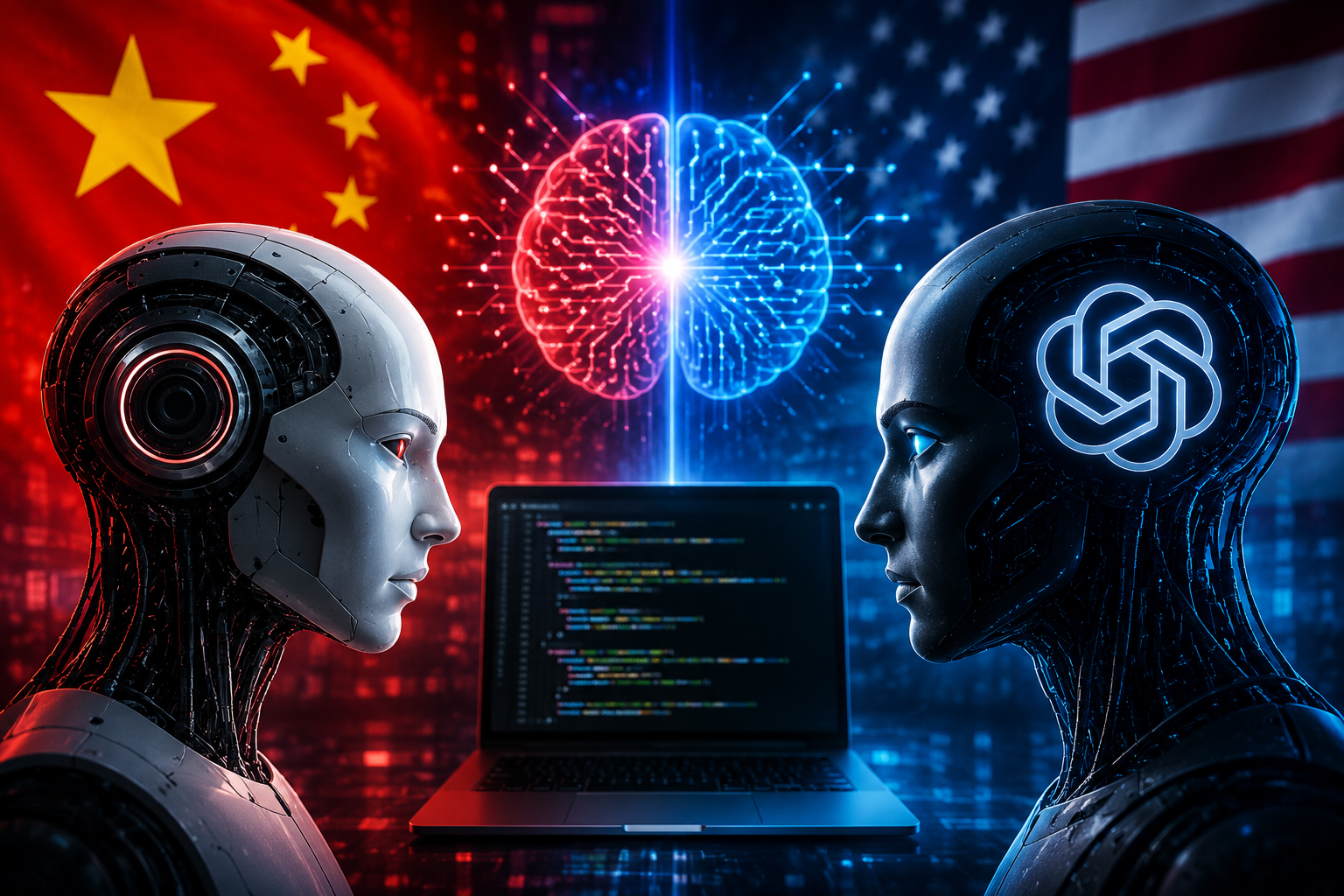
The race in artificial intelligence has become faster than ever. Every month, tech firms launch new AI models with bigger promises. Some say their systems write better code. Others claim stronger reasoning or smarter answers. Now, a Chinese startup called MiniMax has entered the spotlight with a bold statement. The company says its new AI model, called M3, performs better than GPT-5.5 in coding tasks.
This claim has created strong interest in the tech world. Many people now ask if China has built an AI system that can truly challenge the best products from American companies like OpenAI and Google.
What MiniMax Says About M3
MiniMax shared benchmark results that place M3 ahead of GPT-5.5 and Gemini 3.1 Pro on a popular coding test called SWE-Bench Pro. The news quickly spread across the global tech industry. Software developers, investors, and AI experts all started to watch the company closely.
The report matters because coding has become one of the biggest uses of artificial intelligence today. AI tools now help developers write software, fix bugs, study code, and even create full applications. Companies across the world spend billions of dollars on these systems. Because of this, any model that shows stronger coding power gets major attention.
The Importance of SWE-Bench Pro
MiniMax says M3 reached a better score than GPT-5.5 on SWE-Bench Pro. This benchmark tests how well AI systems solve real software engineering problems. Instead of simple questions, the test gives difficult coding tasks that often appear in real projects. The AI must understand the issue, study the code, and provide the correct fix.
Many experts see SWE-Bench Pro as an important test because it checks practical coding ability rather than basic knowledge. Strong results on this benchmark suggest that an AI model may help developers in real work situations.
A Huge Context Window
MiniMax also says M3 supports a context window of one million tokens. This feature allows the model to process huge amounts of information at once. In simple terms, the AI can read and understand very large codebases or long documents without losing track of details.
This large context window may help developers who work on complex projects with thousands of files. Instead of reading small sections one by one, the model can study much larger parts of a project together. That could improve code analysis and problem solving.
China’s Growing AI Industry
The company presents M3 as a direct rival to leading Western AI systems. This marks another major step for China’s growing AI industry. Over the last two years, several Chinese startups have launched advanced AI products that compete with American firms.
Companies such as DeepSeek and Zhipu AI have already gained attention with models focused on reasoning and software development. Now MiniMax hopes to join that group with M3.
The rise of Chinese AI firms has changed the global technology market. Earlier, most people believed the United States would dominate artificial intelligence for many years. OpenAI, Google, Anthropic, and Meta appeared far ahead of competitors. However, recent launches from Chinese firms suggest the gap has become much smaller.
Some experts now believe AI development has entered a new phase where several countries can build top-level systems. This creates stronger competition and faster progress.
Experts Ask for Caution
Still, many researchers urge caution before accepting MiniMax’s claims without question. Benchmark scores do not always show the full picture. Companies often publish their own test results, and outside experts may not immediately confirm them.
A model may perform well on a benchmark but still struggle during real daily use. Developers usually care about more than raw scores. They want stable performance, reliable answers, fewer hallucinations, and smooth tool support.
Long coding sessions also matter. Some AI systems produce strong short answers but fail during larger software tasks. Others handle simple projects well but make mistakes inside complicated applications.
Because of this, many experts say independent testing remains necessary before anyone can declare M3 better than GPT-5.5 overall.
GPT-5.5 Still Holds Strong Position
GPT-5.5 itself already holds a strong reputation in coding. OpenAI designed the model with major focus on software engineering tasks. Many developers use it to write functions, debug programs, explain code, and automate repetitive work.
The system also supports agentic workflows. This means the AI can complete longer chains of actions with less human help. Such features have made GPT-5.5 popular among both individual developers and large companies.
For MiniMax to truly defeat GPT-5.5, the company must prove that M3 performs better not only in tests but also in real software projects. That proof may take months because developers need time to study the model carefully.
Why This News Matters
Another reason this news matters comes from the business side of AI. Investors now view coding models as one of the most valuable areas in artificial intelligence. Companies pay large subscription fees for tools that help software teams save time.
If MiniMax delivers strong real-world results, it could attract global users and major investment. This may also increase pressure on American firms to improve their own systems faster.
The competition between AI companies has become intense. OpenAI, Google, Anthropic, DeepSeek, Zhipu AI, and MiniMax all want leadership in the next stage of artificial intelligence. Every new launch now receives close attention because small performance gains can influence huge business deals.
The Real Test Still Remains
At the same time, many experts believe benchmark battles alone may not decide the future. Cost, speed, trust, privacy, and reliability also play major roles. Companies want AI systems that work smoothly every day, not only during tests.
Developers also prefer models that connect well with existing software tools. Strong support for coding platforms, cloud systems, and enterprise security often matters as much as benchmark scores.
For now, MiniMax has succeeded in one important area. The company has made the world pay attention. A few years ago, only a small number of firms could compete in advanced AI research. Today, new players continue to enter the race with serious technology.
Final Thoughts
Whether M3 truly performs better than GPT-5.5 remains uncertain. Independent reviews and real-world testing will decide that over time. Still, the announcement clearly shows how fast the AI industry continues to evolve.
The global AI race no longer belongs to one country or one company. Chinese startups now stand much closer to American leaders than many people expected. That shift could shape the future of software development, business technology, and artificial intelligence itself.
As competition grows stronger, users may benefit the most. Faster progress usually leads to better products, smarter tools, and lower costs. Developers around the world will now watch closely to see whether MiniMax M3 lives up to the excitement.
Also Read – What Is Venture Capital?