
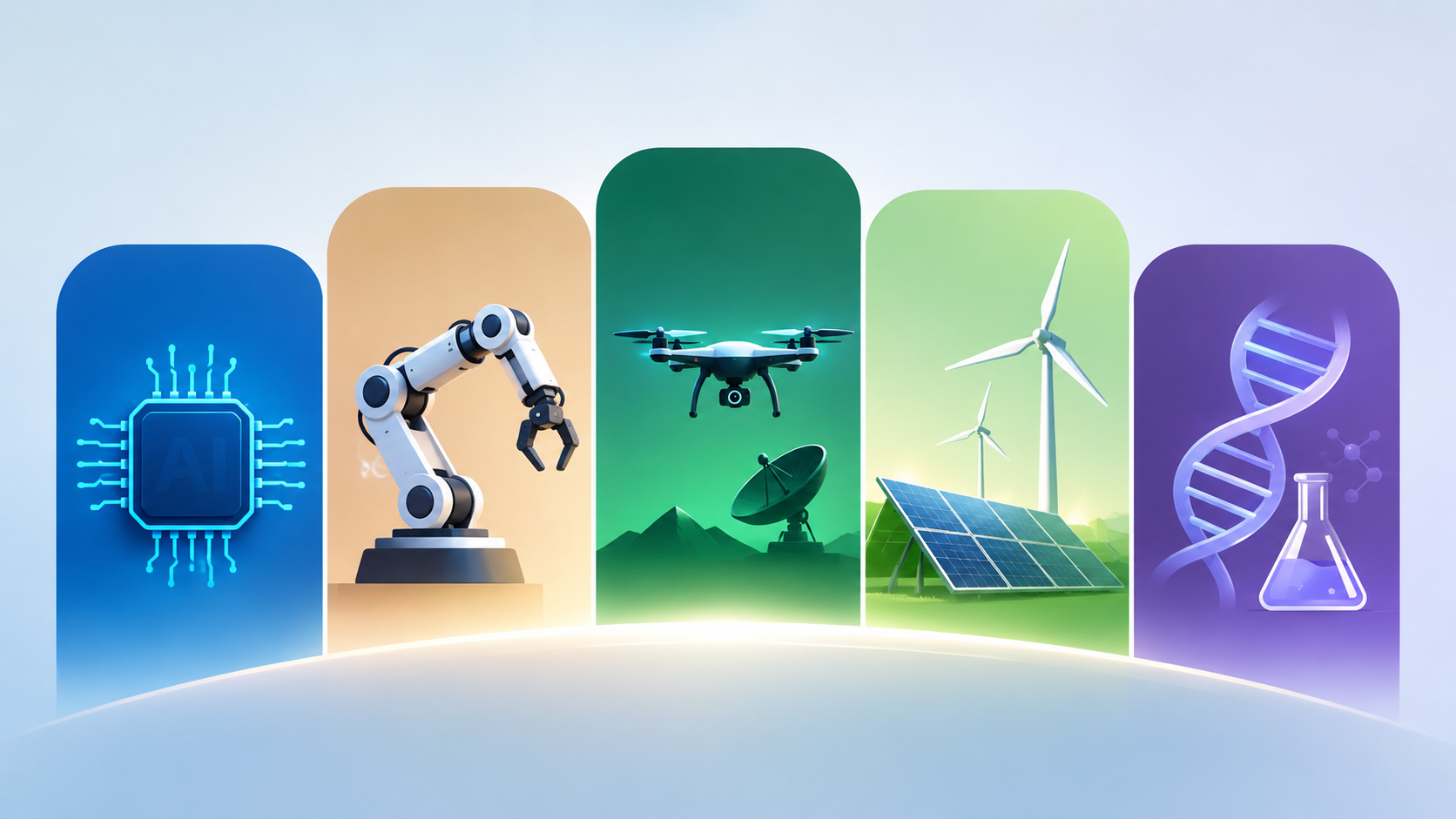
The startup race heading into 2028 will look very different from the one that defined the previous decade. Between 2015 and 2022, entrepreneurs chased food delivery, online education, fintech, e-commerce and direct-to-consumer brands. Those sectors produced some remarkable companies, but they also attracted thousands of competitors who fought over similar customers, business models and investor attention.
The next wave looks more technical, expensive and closely connected to real-world problems. Artificial intelligence now influences how companies build software, robotics promises to change manufacturing, defence technology attracts government attention, energy infrastructure faces growing demand, and biotechnology continues to open new possibilities in healthcare.
These developments create an interesting question: which startup sectors will attract so many founders, investors and established companies that competition could become significantly tougher by 2028?
Five sectors stand out. Current investment figures, startup formation and technological developments already offer clues about where the crowd will gather. For entrepreneurs, the challenge will involve finding a specific problem that competitors have overlooked rather than simply entering a fashionable industry.
1. AI Agents and Vertical AI: Everyone Wants to Build the Next AI Company
Artificial intelligence has already attracted an enormous number of startups, but the next stage of competition will move beyond chatbots and general-purpose assistants. Entrepreneurs now want to build AI agents that can complete entire tasks, operate business software, analyse information and manage workflows with limited human intervention.
Consider a mid-sized insurance company. It might employ separate teams to review documents, check customer information, process claims and respond to routine enquiries. A specialised AI agent could handle several steps in that process, while employees supervise decisions that require judgement or regulatory approval.
This type of opportunity explains why vertical AI could attract another wave of founders before 2028. Every industry has repetitive tasks, expensive administrative processes and gaps in existing software. Healthcare, insurance, accounting, logistics, legal services and manufacturing all offer potential customers.
The investment figures already show how strongly investors favour this category. J.P. Morgan’s Startup Insights H2 2026 report estimates that seed-stage AI investment will reach $15 billion in 2026, compared with $7.4 billion in 2023. At Series A, the report estimates $29.7 billion in AI investment, against $8.5 billion in 2023. These figures suggest that investors continue to commit substantial capital to early-stage AI businesses.
India adds another important dimension. The Nasscom-Zinnov technology startup report puts Indian tech startup funding at $9.1 billion in 2025, up 23% from the previous year. Deep-tech startups raised $2.3 billion, a 37% annual increase, while AI accounted for 84% of deep-tech startups and 91% of deep-tech funding, according to the report.
However, easy access to AI models also creates a serious competitive problem. A small team can launch a basic AI writing assistant or customer-support product without spending years developing proprietary technology. Hundreds of other teams can pursue the same idea.
By 2028, founders will need more than an attractive interface or a clever prompt. Companies that understand a particular industry’s processes, own useful datasets and secure long-term customer relationships will have better chances of defending their positions. The real opportunity lies in solving expensive business problems, not launching another general-purpose AI tool.
2. Robotics and Physical AI: The Competition Moves Beyond Software
For years, robotics startups struggled with high development costs, complicated hardware and limited commercial applications. Advances in computer vision, machine learning, sensors and computing now give entrepreneurs new ways to tackle those problems.
The opportunity extends far beyond humanoid robots. Factories need machines that can inspect products, warehouses need systems that can move inventory, farms need equipment that can monitor crops, and hospitals need tools that can support repetitive clinical tasks.
Industrial automation offers a particularly interesting entry point. A manufacturer does not necessarily need a human-shaped robot. It needs a machine that can reduce production delays, identify defects or handle dangerous work with predictable results.
J.P. Morgan estimates that global seed-stage robotics investment will reach $731 million in 2026, compared with $289 million in 2023. Its Series A estimates also point towards stronger investment in robotics and advanced manufacturing. McKinsey’s 2026 Technology Trends Outlook identifies robotics among five technology trends on course to attract more than twice their 2025 investment during 2026.
India already has a sizeable base of companies working in this area. Deeptech Navigator’s November 2026 research maps 4,720 Indian robotics and automation companies. Its database also records 39 funding rounds in the sector over the preceding 12 months, with approximately $262 million in disclosed funding.
These figures matter for another reason: robotics requires capabilities that many software founders cannot quickly acquire. Hardware design, mechanical engineering, computer vision, component sourcing, testing and after-sales maintenance all create additional challenges. Startups must also convince customers that their machines can operate safely and consistently in real working environments.
By 2028, competition could intensify in warehouse automation, agricultural robotics, industrial inspection and autonomous delivery. Humanoid robots will attract considerable attention, but founders should examine the economics before chasing the headlines.
A company that automates one difficult warehouse operation and saves its customer millions could build a stronger business than a company that spends years developing a general-purpose robot without a clear buyer.
3. Defence Technology and Autonomous Systems: National Security Creates New Buyers
Defence technology has moved closer to the centre of startup investment discussions. Governments increasingly want domestic capabilities in drones, surveillance, satellite intelligence, cybersecurity, secure communications and autonomous systems.
This shift creates opportunities for technology companies that previously struggled to find commercial buyers for specialised products. Defence organisations need reliable equipment and software, while traditional contractors increasingly look towards smaller technology companies for specialised capabilities.
The investment figures reflect this growing interest. Rothschild & Co’s October 2026 growth-equity update reports $5.7 billion in defence fundraising during the first nine months of 2026, compared with $1.7 billion across the whole of 2025. The report also places defence among Europe’s strongest fundraising sectors during the period.
The category covers much more than military hardware. A startup might develop software that detects unauthorised drones around airports, sensors that monitor remote borders, satellite systems that analyse terrain or cybersecurity tools that protect sensitive communications.
India offers a particularly relevant market. The country has pushed domestic defence manufacturing, private-sector participation and indigenous technology development. Startups can explore opportunities in unmanned aerial vehicles, electronic warfare support, aerospace components, simulation software and intelligence systems.
Deeptech Navigator maps 671 Indian defence and security companies as of November 2026. Its funding database records six funding rounds worth approximately $18 million in disclosed investment during the preceding 12 months. The relatively small funding figure compared with other deep-tech categories suggests that the sector still faces significant financing and commercialisation challenges.
Those challenges include lengthy procurement processes, strict testing requirements, security clearances and the need to prove that products can work under demanding conditions. Startups also need to understand government purchasing procedures and build relationships with established defence manufacturers.
By 2028, more entrepreneurs could enter this sector, particularly as governments seek domestic alternatives to foreign technology. The strongest opportunities may emerge in software, detection systems, communications and specialised components rather than expensive platforms that require enormous manufacturing budgets.
4. Climate Technology and Energy Infrastructure: The Power Problem Creates a New Market
Climate technology is entering a new phase. Solar panels and electric vehicles still matter, but the next set of opportunities will also involve electricity storage, grid management, energy efficiency and the infrastructure required to support rising power consumption.
Artificial intelligence adds urgency to this shift. Large data centres need substantial amounts of electricity, and their expansion places additional pressure on power networks. Factories, electric vehicles and industrial equipment also increase demand for reliable energy.
This creates commercial opportunities for startups that can help businesses manage electricity costs, store surplus power, improve energy distribution or reduce waste.
India offers a strong setting for these businesses. The country needs to expand electricity infrastructure while supporting renewable energy, industrial growth and rising demand from urban centres. Companies can explore battery energy storage, solar financing, smart meters, industrial energy management and software that helps businesses monitor consumption.
The funding figures already show investor interest. According to the Ostara Climate Tech and Deep Tech Review 2026, Indian climate-tech companies raised $791 million across 74 equity funding rounds between January and May 2026. Five late-stage transactions accounted for 71% of that total. The report suggests that annual funding could reach approximately $1.9 billion if the early-year pace continues, although that figure represents a run-rate projection rather than a confirmed outcome.
Deeptech Navigator’s November 2026 database also maps 3,269 Indian energy companies and 620 climate and environment companies. Its records show approximately $310 million in disclosed energy-sector funding across 23 rounds over the preceding 12 months.
The sector will attract founders from several backgrounds, including electrical engineering, materials science, software, finance and manufacturing. However, commercial success requires more than an environmental mission. Startups must show customers how much money their products save, how reliably their systems operate and how quickly customers can recover their investment.
By 2028, energy storage, grid software and power management for data centres could attract more competition. Founders who understand local electricity markets and industrial purchasing decisions will have an advantage over teams that develop technology without understanding the economics of deployment.
5. Biotechnology, Longevity and Health Technology: Science Meets a New Generation of Startups
Healthcare startups have attracted entrepreneurs for years, but biotechnology and scientific research now offer opportunities that go far beyond online consultations and appointment-booking platforms.
AI-assisted drug discovery, genetic diagnostics, molecular testing, medical devices and personalised medicine could create entirely new categories of businesses. Longevity research also attracts attention as scientists investigate ageing, metabolic health and the biological mechanisms behind chronic diseases.
The scale of the existing startup base highlights the sector’s importance. WIPO’s Global Innovation Index 2026 identifies more than 11,000 life-sciences startups among the deep-science companies launched between 2015 and 2025. Medical devices and digital health account for another 5,600 startups.
However, the composition of new companies is changing. WIPO reports that life sciences accounted for 55% of new deep-science startups in 2015, but their share fell to 23% in 2025. This does not suggest that healthcare has lost commercial relevance. It shows that other technical categories, particularly robotics and semiconductors, have gained ground in new company formation.
India also has a substantial base in this category. Deeptech Navigator maps 5,603 Indian health and life-sciences companies, the largest sector in its November 2026 database. Its records show 39 funding rounds and approximately $229 million in disclosed funding during the preceding 12 months.
Several opportunities could attract more founders by 2028. These include affordable diagnostic equipment, AI-assisted radiology, genetic testing, laboratory automation, clinical research software and technologies that help doctors identify diseases earlier.
Yet biotechnology demands patience and scientific credibility. A software startup might test a new feature with customers within weeks, while a medical technology company may need years of research, clinical studies and regulatory review. Founders must also consider manufacturing standards, patient safety and reimbursement rules.
The strongest opportunities will come from clear medical needs. A startup that makes an important diagnostic test cheaper and more accessible could create meaningful value. A company that sells unproven longevity claims, on the other hand, may struggle to earn the trust of doctors, regulators and patients.
What These Five Sectors Tell Us About the 2028 Startup Market
These industries share one important characteristic: they attract entrepreneurs who want to solve problems that require more than a website, a marketing campaign or a basic software product.
The competition will not look identical across all five sectors. AI startups may face hundreds of rivals offering similar products, while robotics companies must manage manufacturing costs and technical limitations. Defence businesses need government buyers, climate startups need financing and deployment partners, and biotech companies must establish scientific validity.
India’s deep-tech ecosystem offers another useful indicator. Deeptech Navigator maps 28,889 companies across 15 sectors as of November 12, 2026. Its database records approximately $2.6 billion in disclosed funding across 240 rounds during the preceding 12 months. Health, robotics, energy and computing already account for substantial portions of this company base.
These numbers do not prove that every sector will reach saturation by 2028. They do show that more entrepreneurs already compete for customers, technical talent and investment in these categories.
For founders, the lesson is straightforward. Avoid entering an industry simply because investors discuss it frequently. Study the customer, identify a costly problem and understand what prevents existing companies from solving it. Then build a product that offers a measurable improvement and gives customers a convincing reason to stay.
The next two years could bring a major expansion in AI, robotics, defence, energy and biotechnology. However, the biggest winners may not come from the companies that enter these sectors first or raise the largest funding rounds. They may come from founders who identify overlooked problems, understand difficult technical requirements and build products that customers cannot easily replace.
By 2028, these five sectors may have plenty of startups. The real shortage could be companies that solve their customers’ problems better than everyone else.
Also Read – Alibaba’s T-Head Plans a Hong Kong IPO: What It Means for AI