
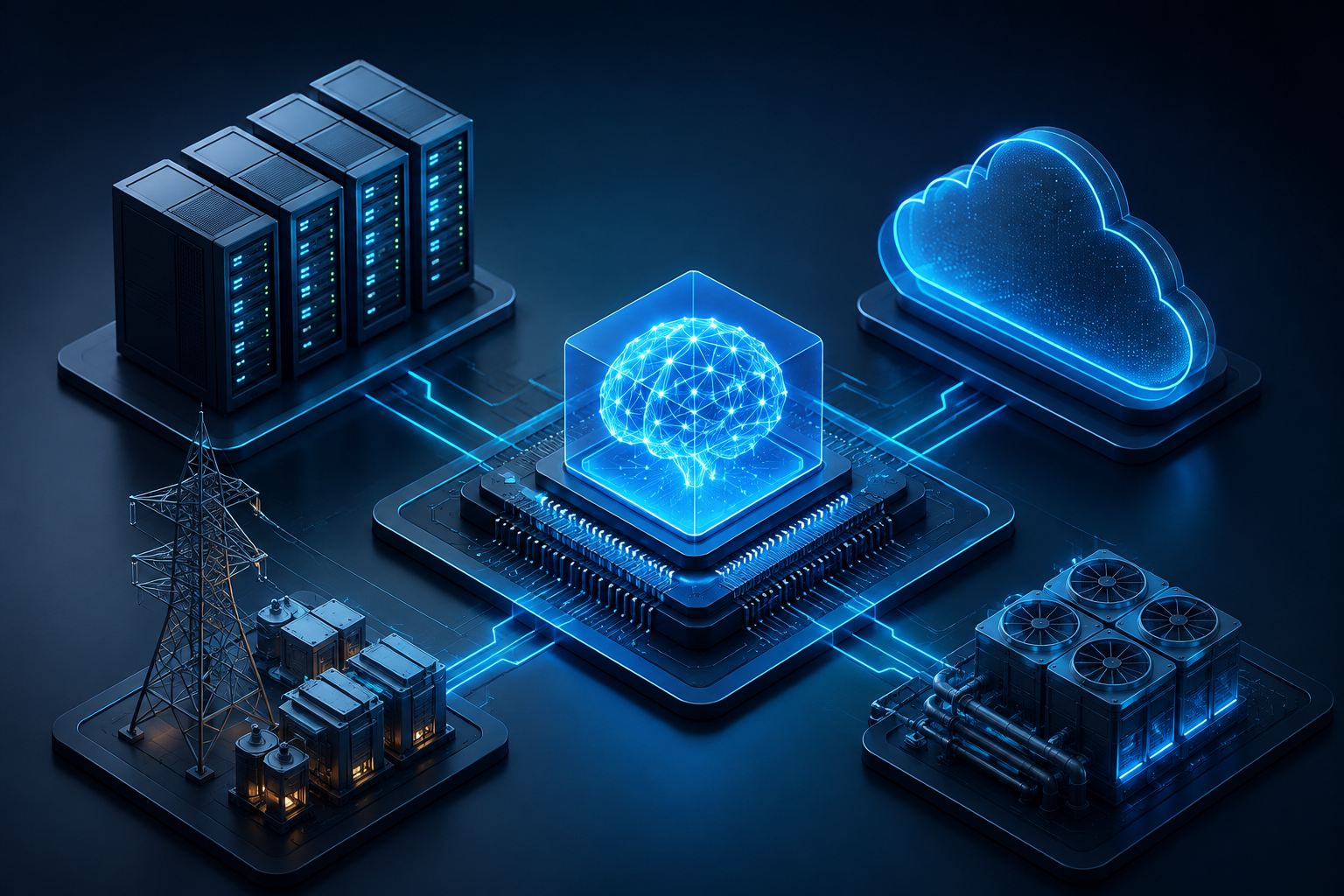
Artificial intelligence has moved far beyond a software story. The next phase now depends on the physical and digital systems that make AI work at scale. Data centers, GPUs, memory, networks, power systems, cooling equipment and cloud platforms now sit at the center of the AI economy.
The numbers show the size of this shift. S&P Global and 451 Research estimate that the global AI infrastructure market will reach $337 billion in 2025 and rise to $1.2 trillion by 2030. That means a market worth more than three times its current size within five years. The total opportunity across 2025 to 2030 reaches about $4.8 trillion.
The most important change sits inside that market. AI inference infrastructure could rise from $101 billion in 2025 to $532 billion in 2030. That represents a 39% compound annual growth rate. Inference should also overtake training and fine-tuning in 2027.
Training and fine-tuning still form a major market. The category could rise from $127 billion in 2025 to $336 billion in 2030, which represents about 21% annual growth. Data ingestion, integration and preparation could rise from $109 billion to $295 billion over the same period.
The figures point toward a clear change. The AI economy now needs systems that can serve models millions or billions of times, not only systems that can train those models.
Inference Could Become the Biggest Opportunity
Training happens when a company creates or improves a model. Inference happens each time that model answers a question, writes code, creates an image, processes a document or completes an action.
That difference matters for startups.
Training can require enormous bursts of compute. Inference can create a constant stream of demand. AI agents, coding tools, enterprise assistants, voice systems and automated workflows can all create more inference traffic.
S&P expects inference infrastructure to reach $532 billion by 2030, compared with $336 billion for training and fine-tuning. Inference also has a much faster projected growth rate of 39%, compared with 21% for training and fine-tuning.
This creates a large opportunity for companies that make inference faster and cheaper. Model serving, routing, caching, scheduling, quantization and workload management can all affect the cost of each AI response.
GPU utilization also matters. NVIDIA has highlighted the effect of utilization on inference economics. A cluster that runs at 40% utilization can have roughly twice the effective cost per token of the same cluster at 80% utilization.
That makes infrastructure software especially attractive. A startup that helps a large customer use existing GPUs more efficiently can create major economic value without selling another physical accelerator.
Hyperscalers Are Creating a Massive Demand Wave
The world’s largest cloud companies now plan extraordinary capital expenditure.
S&P Global Ratings estimates that six major hyperscalers—Alphabet, Amazon, Microsoft, Meta, Oracle and SpaceX—could spend $870 billion in 2026 and more than $1.3 trillion in 2027 on capital expenditure.
McKinsey estimates that Amazon, Google, Meta and Microsoft alone could spend more than $700 billion in 2026, with most of that spending tied to AI infrastructure.
Amazon expects about $200 billion of capital expenditure in 2026. The company has also said that much of its AWS investment already has support from customer commitments.
Meta expects $125 billion to $145 billion of 2026 capital expenditure, including finance-lease payments. AI infrastructure needs form a major part of that plan.
Such figures change the startup opportunity. The central question no longer concerns whether AI infrastructure will receive large amounts of capital. The larger question concerns which scarce part of the infrastructure stack can capture the most value.
AI Neoclouds Have Become Major Companies
AI neoclouds have emerged as one of the clearest startup categories. These companies provide access to large pools of AI compute and often combine GPUs, data centers, networking and software.
Nscale raised $2 billion in Series C funding at a $14.6 billion valuation. The company focuses on AI infrastructure across compute, networks, data services and orchestration.
Nscale also has a major reported customer commitment. Anthropic reportedly agreed to spend $45 billion over six years on computing capacity from Nscale. The West Virginia facility linked to that deal could provide about 460 MW of power capacity.
Lambda has followed a similar path. The company raised more than $1.5 billion in Series E funding and has plans for gigawatt-scale AI factories. In August 2026, Reuters reported an agreement between Anthropic and Lambda worth about $35 billion, tied to roughly 350 MW of capacity in Texas.
Together AI also shows how quickly the category can grow. The company raised $102.5 million in Series A, followed by $305 million in Series B at a $3.3 billion valuation, and then $800 million in Series C at an $8.3 billion valuation.
These deals show a major shift in the cloud market. Frontier AI companies now need computing capacity at a scale that can support long-term infrastructure contracts worth tens of billions of dollars.
Inference Software Could Offer Better Startup Economics
Physical AI infrastructure requires huge amounts of capital. Software can offer a different model.
Baseten raised $1.5 billion in Series F at a $13 billion valuation in June 2026. The company reported 20× revenue growth over the prior year and 40× growth in inference volume.
Modal raised $355 million in Series C at a $4.65 billion valuation in May 2026. The company reported 5× growth since September and more than $300 million in annualized revenue.
Fireworks AI raised $250 million in Series C at a $4 billion valuation. The company has raised more than $327 million in total funding and has customers such as Uber, Genspark and Shopify.
These examples show a common pattern. Investors now place high value on companies that help enterprises run AI models in production. The value sits less in raw compute access and more in the systems that make that compute useful.
AI Chips Still Offer Huge Potential
Specialized AI chips remain another major category. Cerebras has become one of the strongest examples.
Cerebras raised $1.1 billion in Series G at an $8.1 billion valuation in 2025. It later raised $1 billion in Series H at a valuation of about $23 billion in February 2026.
The company’s WSE-3 processor has a very different design from standard GPUs. Cerebras says the processor is 56 times larger than the largest GPU.
Yet AI chip startups face a serious challenge. Chip design requires enormous capital, long development cycles and strong software support. A new accelerator also faces rapid changes in the hardware market.
Groq offers a useful example. The company raised $750 million at a $6.9 billion valuation in September 2025. Its latest $350 million financing placed the valuation at $3.5 billion in 2026. That represents about a 49% reduction from the earlier reported valuation.
The lesson is clear. A strong chip alone does not guarantee a durable infrastructure business.
Power Has Become an AI Bottleneck
AI needs electricity at an unprecedented scale.
The International Energy Agency estimates that global data-center electricity use could rise from about 460 TWh in 2024 to around 945 TWh in 2030. That represents roughly a doubling within six years.
Accelerated servers, which support much of the AI workload, could grow their electricity use by around 30% each year and account for almost half of the net increase in data-center electricity demand.
This creates a large market for power infrastructure. Startups can target grid connections, batteries, power conversion, transformers, switchgear, microgrids, energy procurement and power-management software.
The US grid already shows signs of pressure. Reuters reports that some high-voltage transformer lead times have reached 160 weeks, compared with 143 weeks in 2024.
US data-center power demand could rise from about 24 GW in 2026 to 110 GW in 2030. That scale makes electricity access a core part of AI capacity.
Texas has received more than 474 GW of data-center power requests, with another roughly 270 GW elsewhere. Authorities now face the challenge of separating serious projects from speculative requests.
The scarce resource may no longer sit only inside a semiconductor factory. A startup that can secure reliable power for a large AI campus can hold a very valuable asset.
Cooling Has Become Part of Compute Economics
AI servers create far more heat than traditional enterprise systems. Higher rack density places new demands on data-center cooling.
Technavio forecasts an additional $2.48 billion market opportunity for AI data-center liquid cooling between 2025 and 2030, with a 31.7% compound annual growth rate.
That market includes direct-to-chip cooling, cold plates, immersion cooling, coolant distribution units, heat exchangers and thermal monitoring.
Cooling now affects compute capacity itself. A data center can have enough GPUs but still face limits if its cooling system cannot handle the heat.
This makes thermal technology more than a facility concern. It has become part of the AI performance equation.
Networking and Optics Could Create Another Giant Market
Large AI clusters need fast communication between processors. As clusters grow, data movement becomes almost as important as computation.
NVIDIA’s GB200 NVL72 shows the scale of modern AI systems. One rack contains 72 Blackwell GPUs and 36 Grace CPUs, with 130 TB/s of NVLink communication bandwidth and liquid cooling.
Optical technology could see especially strong demand. TrendForce forecasts the co-packaged and near-packaged optics market to rise from about $100 million in 2025 to more than $39 billion in 2030.
Another 2026 forecast places the broader data-center optical-interconnect market at $144.4 billion by 2030, compared with $13.7 billion in 2024. That implies roughly 48% annual growth.
TechInsights estimates optical transceiver revenue could reach $84.3 billion by 2030, compared with $9.7 billion in 2025. The same analysis suggests optical-interconnect power use could exceed 2.5 GW under older architectures.
These figures create strong opportunities in silicon photonics, optical I/O, lasers, transceivers and high-speed switching.
Memory Has Become Another Scarce Resource
AI accelerators need high-bandwidth memory, or HBM, to process large models at high speed.
SK hynix cites estimates that the HBM market could reach $54.6 billion in 2026, up about 58% from the prior year. The company also cites forecasts that custom HBM demand for ASIC-based AI chips could rise 82%.
Reuters reports that SK hynix holds about 58% of the global HBM market and expects memory shortages to remain a concern toward 2030.
The broader semiconductor market could approach $1 trillion in 2026.
This creates opportunities beyond memory chips themselves. Advanced packaging, memory bandwidth, substrates and high-speed interconnects all form part of the same system.
Power and Compute May Merge Into One Business
Crusoe offers one of the clearest examples of this new model.
The company raised $1.375 billion in Series E at a valuation above $10 billion. Its energy pipeline grew more than four times to more than 45 GW, while Crusoe Cloud bookings grew 5× year over year during the first three quarters of 2025.
Crusoe combines energy, data centers and AI compute.
That model could become more common. A company that controls power, land, cooling and compute can build a stronger position than a company that only rents GPUs.
Infrastructure Finance Has Become a New Market
AI infrastructure requires so much capital that finance itself now forms part of the opportunity.
CoreWeave closed a $3.1 billion publicly syndicated HPC-backed loan facility in May 2026. The company described the structure as the first publicly syndicated financing vehicle backed by high-performance computing infrastructure.
CoreWeave had earlier secured a $2.6 billion financing facility, which helped push its total capital commitments above $25 billion at that stage.
The market can now support GPU-backed lending, compute receivables finance, GPU leasing, infrastructure asset-backed securities, project finance and long-term capacity contracts.
That creates space for financial companies built specifically around AI infrastructure.
Where the Next Big Bets May Sit
The strongest opportunity may sit inside inference infrastructure. The market could reach $532 billion by 2030, with a projected 39% compound annual growth rate.
Power infrastructure comes next. AI data centers cannot operate without reliable electricity, and grid capacity now limits new projects in several major markets.
Networking and optics also deserve close attention. Large clusters need faster links, while optical technology can reduce communication limits across AI systems.
GPU utilization software offers another attractive area. Better scheduling, routing, caching and workload placement can improve the economics of expensive hardware.
Liquid cooling, HBM, advanced packaging and AI infrastructure finance also offer strong long-term potential.
Specialized chips can produce enormous returns, but they carry much higher technology and capital risk.
The New AI Infrastructure Stack
The AI stack now extends far below the model itself. Applications sit at the top, followed by agents and model services. Below that layer sit inference systems, GPUs and ASICs, HBM, storage, networking, optics, power delivery, cooling, data centers, land, energy and finance.
Each layer has its own bottleneck.
The most valuable startups may control one of those bottlenecks rather than compete directly with NVIDIA or the major cloud companies.
The strongest businesses can combine scarce resources with software efficiency. A company with secured power, strong utilization, long-term customer contracts and a useful software layer can build a much stronger position than a simple GPU rental provider.
The Core Investment Thesis
The first phase of the AI boom focused on models and GPUs. The next phase focuses on the systems that make those models affordable and available at scale.
The global AI infrastructure market could reach $1.2 trillion by 2030. Hyperscalers could spend more than $1.3 trillion in 2027. Inference could reach $532 billion, accelerated compute-as-a-service could reach $145 billion, and AI infrastructure hardware could reach $946 billion.
Those figures create a huge market, but size alone does not guarantee a strong startup.
The best opportunities sit where AI faces a real physical or economic constraint. Power, inference cost, GPU utilization, networking, cooling, memory and infrastructure finance all meet that test.
The central shift is simple. AI infrastructure has moved from a race for more GPUs to a race for more useful intelligence per dollar, per watt, per rack and per second. The startups that solve those constraints could become the next major infrastructure companies.
Also Read – Startup Ideas for Solopreneurs: 30 Businesses You Can Run Alone