
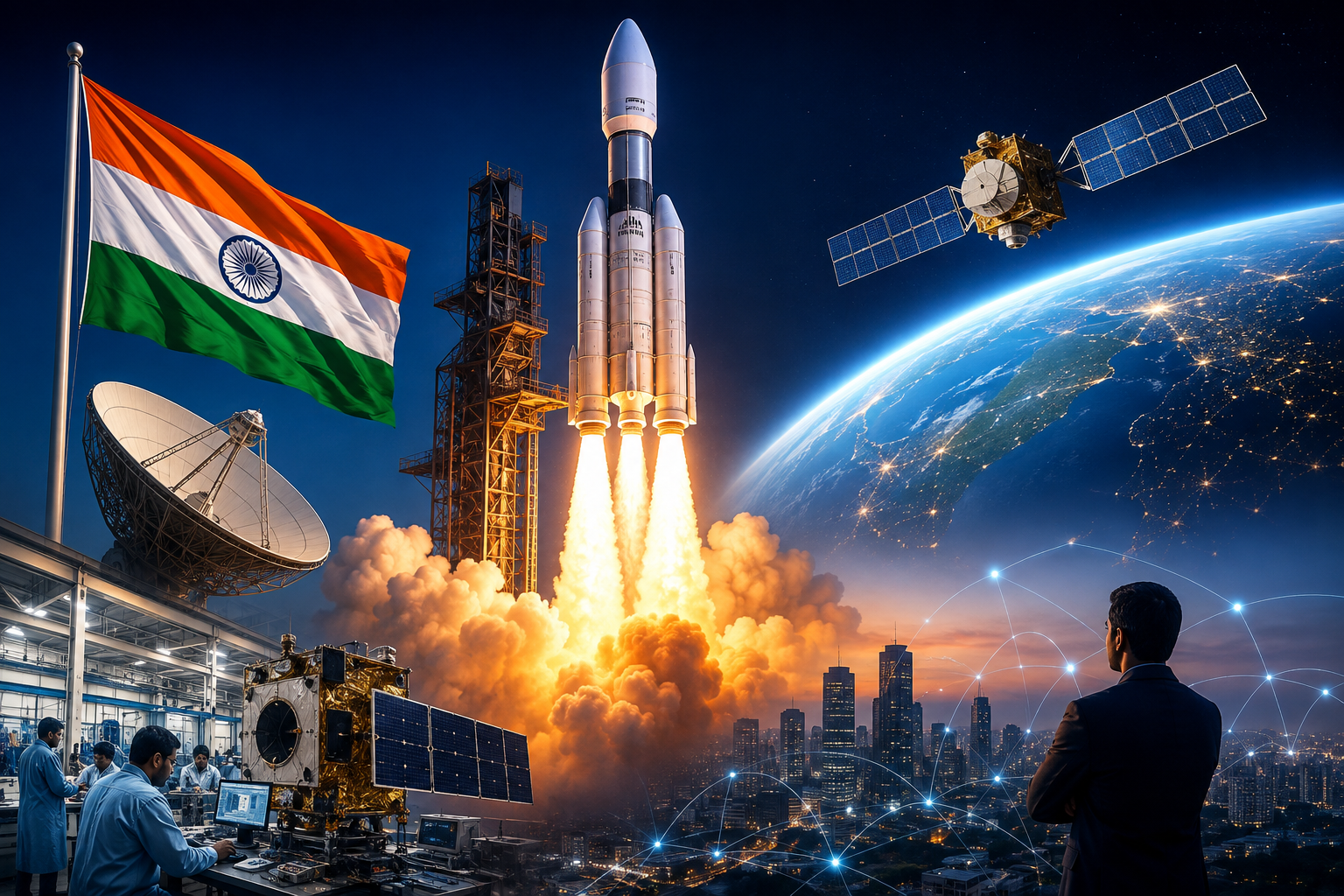
India’s space sector stands at the start of a major change. For many years, space work in the country was led almost fully by the government. The Indian Space Research Organisation, or ISRO, played the main role in rocket launches, satellite work and space missions. Private firms had a much smaller role.
That picture is now changing. Private space companies have moved from early tests and prototypes toward real commercial products. They now aim to build rockets, satellites and services that can serve customers in India and across the world.
This shift could have a major effect on the size of the space economy. India’s space economy could grow roughly fivefold to $45B by 2030. Such a rise would show that space is no longer only about national missions or scientific goals. It could also become a large business sector with value across many parts of the economy.
From Prototypes to Real Business
A key part of this change is the move from prototypes to commercial use. A prototype can prove that a new idea works. A business needs much more. It needs reliable products, regular customers, safe operations and a clear path to profit.
Indian space startups are now at this important stage. Several private firms have worked on launch vehicles, satellites, space hardware and related systems. Their goal is not simply to build a new machine. They want to create products that customers can buy and use more than once.
This is important because space is a difficult and costly field. A company may spend years on research before it can earn a large return. It also faces strict safety rules and complex technical challenges. A successful private space sector therefore needs both strong technology and strong business plans.
The move toward commercial rockets could be one of the biggest changes. Private launch firms can offer more choices to satellite companies and other customers. If these firms can provide safe and reliable launches at competitive prices, demand could rise over time.
Rockets Could Create a New Market
Rockets are among the most visible parts of the space economy. They take satellites and other equipment beyond Earth and into orbit. Until recently, this area had very limited space for private Indian companies.
That is changing as new firms develop their own launch systems. Their work could help India build a stronger commercial launch market. A larger group of launch providers could also create more competition and new ideas.
The business case is clear. More satellites need more launches. Companies that offer space-based internet, Earth observation, navigation and other services need a way to place their equipment in orbit. As satellite use grows, launch services could gain from that demand.
Still, success will depend on reliability. Customers cannot afford frequent delays or failed missions. Private launch firms will need to prove that their rockets can work safely and on a regular basis.
Satellites Will Remain Central
Satellites form another major part of the opportunity. They support many services that people use every day, even when they do not notice them. Communication, weather data, maps, navigation and Earth observation all depend on space-based systems.
Indian companies can take part in this market through satellite design, production and related equipment. Better access to private capital and new technology could help these firms grow faster.
Earth observation may prove especially useful. Satellites can collect data about farms, forests, roads, cities, oceans and weather. Businesses and public agencies can use this information to make better decisions.
For example, satellite data can help track crop health, study changes in land use or watch large areas after a natural disaster. This creates value on Earth, not just in space.
The Rise of In-Space Services
The next major area could be in-space services. This part of the market is still young, but it has strong long-term potential.
In-space services can include work done after a satellite reaches orbit. Companies may offer satellite support, movement between orbits, repairs, inspection or other forms of space assistance. Over time, new technology could also make it possible to create certain products in space.
Such services could become more important as the number of satellites in orbit rises. A larger space economy needs more than rockets and satellites. It also needs companies that can help space assets work for longer and operate more efficiently.
This area may also create opportunities that do not exist today. New business models can appear as technology becomes cheaper and more reliable.
Private Capital Has a Bigger Role
Money will be a major factor in this transformation. Space companies need large amounts of capital before they can reach the market. Rocket development, satellite production and space systems all require long research and test cycles.
Private investment can help companies cross this difficult gap. It can give startups the funds they need to move from an idea to a tested product and then to a commercial service.
At the same time, investors will expect results. Space companies must show that they can build useful technology and create a business around it. Strong technical skills alone may not be enough.
This could lead to a healthier space market. Firms with strong products and clear customer demand may attract more capital, while weaker business models may struggle.
Government Still Has an Important Role
A larger private sector does not mean the government will become less important. In fact, public policy may help decide how fast the space economy grows.
Clear rules can give private companies more confidence. Access to launch facilities, space data, research support and other infrastructure can also reduce barriers for new firms.
Government demand can matter as well. Public agencies can become customers for satellite data, launch services and other space products. This can give young companies an early market while they build a wider customer base.
India also needs rules that support safety and responsible use of space. More private activity means more launches, satellites and space assets. A clear system can help the sector grow without creating unnecessary risks.
India Could Gain a Global Position
The opportunity is not limited to the domestic market. India has already built a reputation for capable space missions at relatively low cost. Private companies could use this foundation to compete in global markets.
A successful commercial space sector could create new exports, attract foreign capital and support high-skill jobs. It could also help Indian companies become suppliers to international satellite and launch firms.
The wider benefits could reach beyond space companies themselves. A stronger space sector creates demand for electronics, software, advanced materials, engineering and manufacturing. Universities and research centres could also gain from greater activity.
This means the effect of a $45B space economy could extend well beyond rockets and satellites.
The Road Ahead
The path to $45B by 2030 will not be easy. Space remains a high-risk business. Technical failures, high costs, delays and changes in global demand can affect companies very quickly.
Yet the direction is clear. Private firms are no longer limited to early experiments. They are moving toward commercial rockets, satellites and in-space services.
The next few years will show which companies can turn strong technology into lasting businesses. Those that succeed could help reshape India’s role in the global space market.
A Fivefold Opportunity
A roughly fivefold rise to $45B by 2030 would mark a major milestone for India. More importantly, it would show the arrival of a broader space ecosystem, where government agencies and private companies work side by side.
Rockets could provide access to orbit. Satellites could deliver valuable data and communication services. In-space services could create a new layer of business above Earth.
India’s space story is therefore entering a new chapter. The country has already shown that it can reach space. The bigger question now is whether its private companies can turn that capability into a large, reliable and globally competitive industry. If they can, the next phase could be far bigger than the one that came before it.
ALSO READ: InstaAstro Raises $12 Million to Expand Spiritual Wellness