
UK EnergyTech startup Certain Energy has raised €11.6 million to help take its long-duration energy storage technology closer to the market. The company was formerly known as RFC Power and has developed a flow battery based on manganese.
The latest funding is a major step for the company as it moves from research and development toward commercial use. The official announcement describes the deal as a £10 million Series A round, which is about €11.6 million. The round includes a £3.5 million investment from the British Business Bank, along with support from Centrica Energy, Ceres Power Holdings and Temasek Trust’s Catalytic Capital for Climate and Health, known as C3H.
Certain Energy wants its technology to help power grids store clean electricity for much longer periods than standard battery systems. Its goal is simple: store power when supply is high and release it when the grid needs it.
Why Long-Duration Storage Matters
Solar and wind power can produce large amounts of electricity when weather conditions are right. But power demand does not always match that supply.
A sunny afternoon can create more solar power than a grid needs at that moment. Strong winds can create a similar issue. Later, when the sun sets or wind levels fall, the grid may need extra power.
Energy storage can help solve this gap. Batteries can take extra electricity, hold it and release it at a later time.
Most battery projects today focus on relatively short periods. Certain Energy has a different target. Its technology aims to store power for hours, days and even weeks. That makes the company part of the wider long-duration energy storage market, also known as LDES.
This type of storage could become more important as countries add more wind and solar power to their electricity systems.
A Manganese-Based Flow Battery
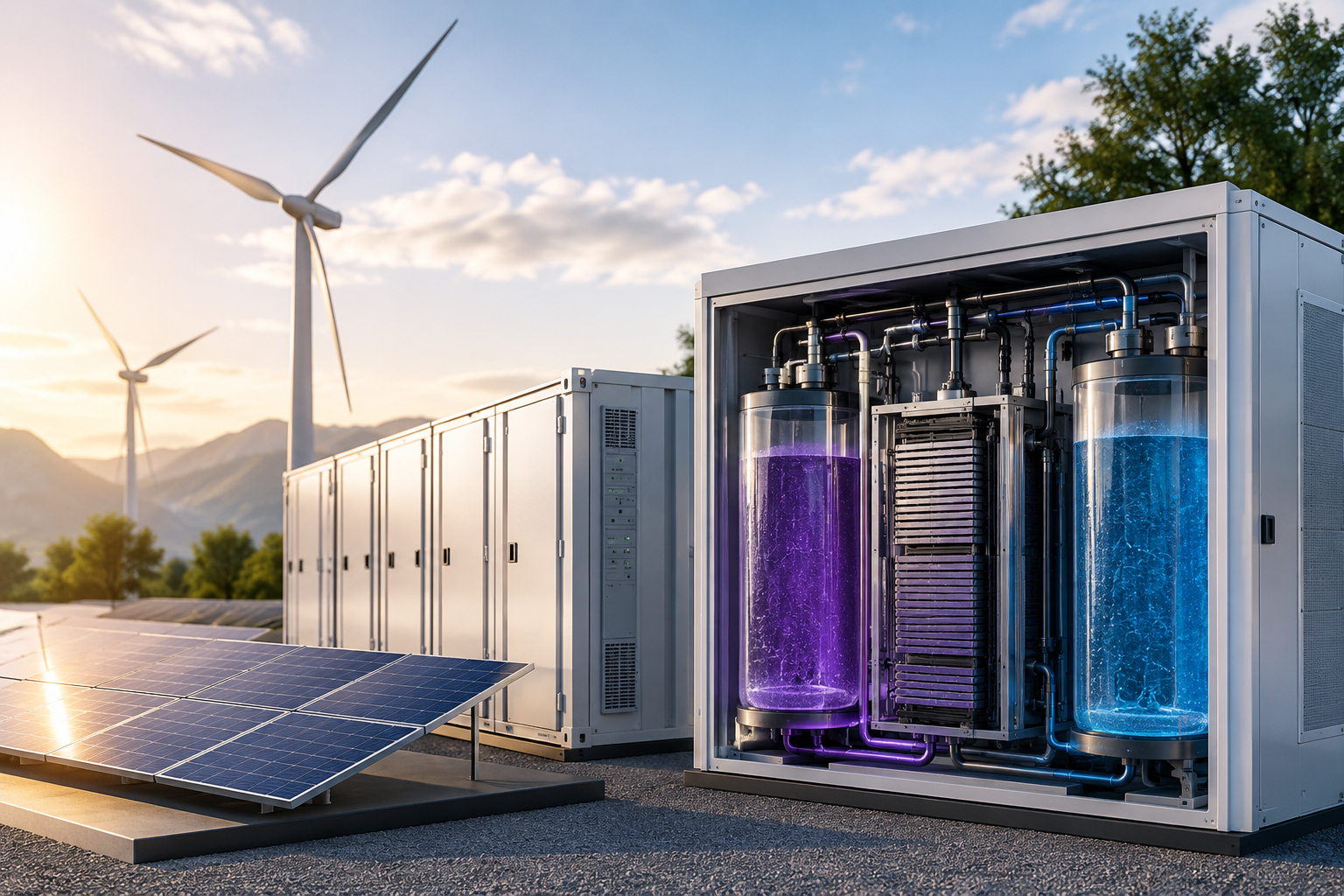
Certain Energy uses a manganese-based flow battery. Flow batteries differ from the lithium-ion batteries used in many electric vehicles and energy storage sites.
A flow battery uses liquid electrolytes stored in external tanks. These liquids pass through an electrochemical cell to create electricity. The size of the tanks can rise when a project needs more energy storage capacity.
This design gives flow batteries an important advantage for long-duration use. A larger tank can hold more electrolyte, which can allow the system to supply power for a longer period.
Certain Energy says its patented design can offer a lower-cost route to long-duration storage. The company also says manganese is attractive because it is an abundant element. Manganese ranks as the 12th most abundant element in the Earth’s crust, according to the British Business Bank.
The company believes this material choice can help lower costs when compared with some other flow battery systems.
A Different Role From Lithium-Ion Batteries
Lithium-ion batteries have become a major part of the energy storage market. They can react fast and work well for many applications. However, very long storage periods can create different cost and system needs.
Certain Energy is not simply trying to replace lithium-ion batteries in every use. Its focus is on areas where the grid needs power for much longer periods.
The company says its system can compete with lithium-ion batteries for key grid services while also offering longer storage and reserve capacity. A report on the Series A says Certain Energy targets a round-trip efficiency above 75%.
The company also says its patented electrolyte has a 20-year operating life with limited capacity loss. It has further stated that its design could reduce marginal storage costs to about one-tenth of comparable vanadium flow batteries.
These claims will become more important as the technology moves from development to larger real-world projects.
The India Project
One of the most important plans tied to the new funding is a grid-connected MWh-class system in India.
The project will give Certain Energy a chance to test its technology at a larger scale and in a real grid environment. India has a fast-growing need for power, while solar and other renewable sources have become an important part of its future energy plans.
Long-duration storage can help such grids deal with changes in renewable power supply. It can also help reduce the need for fossil fuel plants that only operate when the grid faces a short supply of electricity.
The new funding will support the India project, as well as further work at Certain Energy’s UK research facility. The company also plans to create a supply chain that can support repeat commercial projects.
Support From Major Investors
The funding also shows wider support for Certain Energy’s approach.
The British Business Bank has invested £3.5 million in the company. Other participants include Centrica Energy, Ceres Power Holdings and Temasek Trust’s C3H.
For a young EnergyTech company, this type of support can help cover the high cost of moving from laboratory work to commercial hardware.
Battery companies often face a difficult step at this stage. A technology may work at a small scale, but large projects can require new supply chains, larger equipment, stronger quality controls and major capital.
Certain Energy will now use the new funds to address those needs.
From RFC Power to Certain Energy
The company began in 2017 as a spinout from Imperial College London. At that time, it was known as RFC Power.
The new name, Certain Energy, comes with a wider commercial goal. The company is no longer focused only on laboratory research. It wants to build a practical energy storage business that can serve power grids.
Its work remains based on research from Imperial College London, while its current plan focuses on product development, tests, scale and commercial use.
The Bigger Grid Challenge
The need for better storage comes from a basic problem in modern power systems.
Electricity supply must stay close to demand. Renewable power can make that task harder because output depends on weather. A grid with more wind and solar power therefore needs more ways to shift electricity from one time to another.
Without enough storage, clean power can go unused when supply is higher than demand.
The British Business Bank said the UK spent about £1.5 billion last year to ask renewable power producers to reduce output during periods of excess supply. It also cited an estimate that this cost could rise toward £8 billion per year by 2030 if the issue remains unresolved.
Long-duration storage could reduce some of that waste by holding excess power for later use.
What Comes Next for Certain Energy
The €11.6 million raise gives Certain Energy more room to turn its manganese flow battery from a promising technology into a commercial product.
The next phase will be important. The company must prove that its system can work reliably at larger scale, keep costs under control and meet the needs of grid operators.
Its India project could provide a key test. At the same time, the UK research site and planned supply chain could help prepare the company for wider deployment.
Certain Energy is entering a market with strong demand but also serious competition. Its use of manganese, long storage duration and focus on lower cost could give it a clear place in that market if the technology performs as expected.
For now, the €11.6 million raise marks a major milestone. It gives the former RFC Power a stronger base as it seeks to help grids store clean electricity for much longer periods — from hours to days and, ultimately, weeks.
ALSO READ: Even Healthcare Lines Up ₹208 Crore Series B – Startup Wired