
India’s quick commerce industry has transformed from a pandemic-era convenience into one of the country’s most fiercely contested digital markets. What began as 30-minute grocery deliveries has evolved into a battle to deliver everything—from vegetables and medicines to smartphones and cosmetics—in under 10 minutes.
At the center of this race are three dominant players: Blinkit, owned by Zomato (now Eternal), Zepto, the startup founded by Aadit Palicha and Kaivalya Vohra, and Swiggy Instamart, backed by food delivery giant Swiggy. Together, these companies have redefined consumer expectations and are shaping the future of retail in India.
The question now is simple: Who actually rules the quick commerce market?
The Size of the Opportunity
India’s quick commerce market has entered hyper-growth mode. Industry estimates suggest the sector reached roughly $7–8 billion in gross merchandise value (GMV) by 2025 and could triple over the next few years as adoption expands beyond major metros.
Research firms project continued double-digit to high-double-digit growth through the decade, fueled by increasing smartphone penetration, urban lifestyles, digital payments, and growing consumer preference for convenience.
Unlike traditional e-commerce, where delivery may take one or two days, quick commerce focuses on “instant fulfillment” through strategically located dark stores and optimized logistics networks.
Blinkit: The Market Leader
If market share is the primary measure of success, Blinkit currently sits on top of the industry.
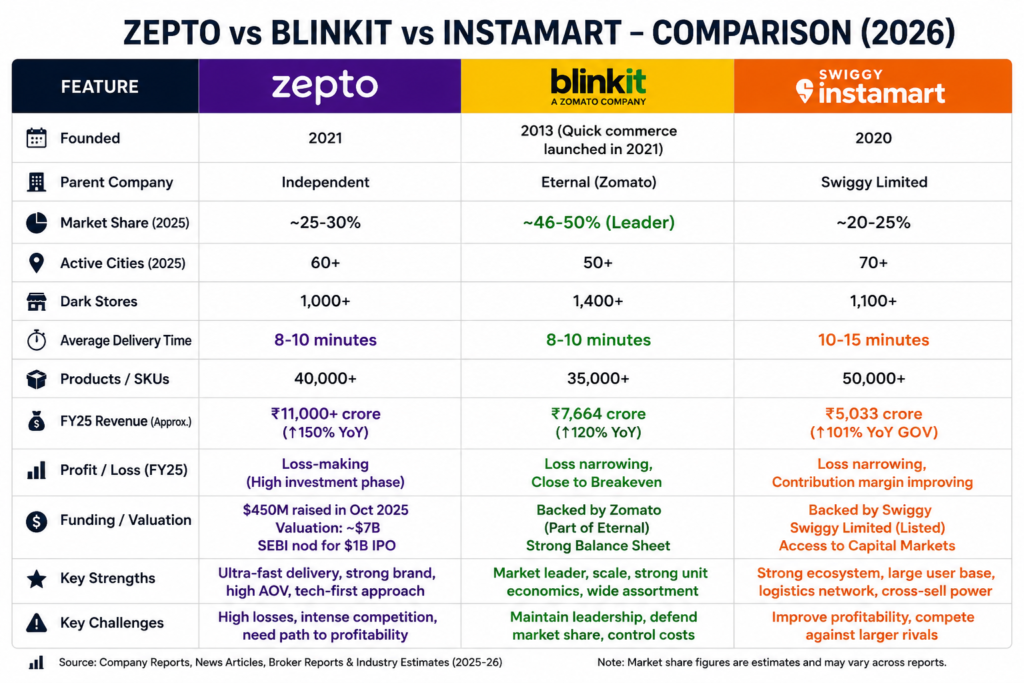
Several industry reports and brokerage estimates place Blinkit’s market share between 46% and 50%+, making it the largest quick commerce platform in India.
Blinkit’s biggest advantage is scale. The company has invested aggressively in dark stores, inventory management, and delivery infrastructure. Analysts increasingly view Blinkit as the benchmark for operational efficiency in the sector. Reports indicate that Blinkit is ahead of rivals in unit economics and has made significant progress toward profitability.
Deepinder Goyal recently argued that Blinkit’s strength comes not from excessive discounting but from customer retention, assortment quality, and execution. He even suggested that Blinkit has a better chance of winning the quick commerce race than global giants such as Amazon.
Blinkit’s strengths include:
- Largest market share
- Extensive dark store network
- Strong parent-company backing
- Better progress toward profitability
- Broad product assortment beyond groceries
Its challenge, however, is maintaining growth while defending market leadership against increasingly aggressive competitors.
Zepto: The Fastest Rising Challenger
Few startups in India have grown as rapidly as Zepto.
Founded in 2021, Zepto built its brand around ultra-fast delivery and a youthful, technology-first identity. While Blinkit enjoys scale, Zepto has emerged as the industry’s most aggressive challenger.
The company’s FY25 revenue reportedly surged nearly 150% year-over-year to more than ₹11,000 crore, reflecting extraordinary demand growth.
Zepto has also attracted massive investor confidence. In one of the biggest funding rounds in the sector, the company raised $450 million at a valuation of approximately $7 billion, strengthening its balance sheet ahead of a planned public listing.
More recently, Zepto received regulatory approval for a proposed $1 billion IPO, highlighting investor belief that the company could become one of India’s most valuable consumer internet businesses.
Where Zepto stands out is speed and brand perception. Many consumers associate Zepto with the fastest delivery times and a premium customer experience. Industry observers frequently cite its strong average order values and appeal among younger urban users.
However, rapid growth has come at a cost. Despite soaring revenue, Zepto continues to report significant losses as it prioritizes expansion and market share acquisition.
Swiggy Instamart: The Ecosystem Player
While Blinkit leads and Zepto grabs headlines, Swiggy Instamart remains a formidable competitor.
Instamart benefits from integration with the broader Swiggy ecosystem, which includes food delivery, Swiggy One memberships, and an established logistics network. This cross-platform advantage helps Instamart acquire and retain users more efficiently than many standalone competitors.
The company has expanded aggressively. Swiggy reported over 100% year-over-year growth in gross order value (GOV) in one quarter while rapidly increasing its dark store footprint across India.
Recent financial results also show improving economics. Swiggy’s losses narrowed sequentially, supported by stronger Instamart performance and increasing network density. The company’s contribution margins have steadily improved despite ongoing investment.
Instamart’s key strengths include:
- Access to Swiggy’s large user base
- Strong logistics infrastructure
- High SKU variety
- Rapid expansion into new cities
- Cross-selling opportunities with food delivery
The challenge for Instamart is proving it can achieve profitability while competing against Blinkit’s scale and Zepto’s aggressive growth strategy.
The Market Share Battle
The exact market share numbers remain debated because different brokerages and research firms use different methodologies.
However, most industry estimates agree on one trend: Blinkit remains the leader, while Zepto and Instamart compete intensely for second place.
Some reports suggest Blinkit controls roughly half of the market, with Zepto and Instamart splitting much of the remainder.
The rivalry between Zepto and Instamart has become particularly intense. Market share reports have periodically suggested Zepto overtaking Instamart, although Swiggy has publicly challenged some of those claims.
What is clear is that no competitor has yet established an unassailable lead beyond Blinkit’s current advantage.
Beyond Groceries: The Next Growth Frontier
Quick commerce is no longer just about groceries.
All three platforms are expanding into categories such as electronics, beauty products, fashion accessories, pet care, gifting, and even premium products. Zepto now offers tens of thousands of products beyond everyday essentials.
This diversification is critical because larger basket sizes improve profitability and help justify the cost of ultra-fast delivery.
Companies are also investing heavily in artificial intelligence, inventory forecasting, and route optimization to improve margins and customer experience.
Who Is Winning?
The answer depends on the metric being measured.
Blinkit wins on market leadership, scale, and profitability progress. It currently has the strongest position and appears best placed to dominate the industry if execution remains strong.
Zepto wins on momentum and investor excitement. Its explosive growth, funding strength, and upcoming IPO make it the most closely watched challenger.
Instamart wins on ecosystem integration. Its connection to Swiggy’s broader platform gives it unique customer acquisition and retention advantages.
The Road Ahead
The quick commerce war is far from over.
Competition is intensifying as Amazon, Flipkart, BigBasket, and other players expand their own instant-delivery ambitions. Industry leaders themselves acknowledge that the market may not sustain the current number of competitors indefinitely.
For now, Blinkit leads the race, Zepto is the fastest-growing challenger, and Instamart remains a powerful contender backed by one of India’s strongest consumer internet companies.
The ultimate winner will not simply be the company that delivers fastest. It will be the one that balances speed, scale, profitability, and customer loyalty in a market that is redefining how India shops.
Also Read – What Is Product-Market Fit?