
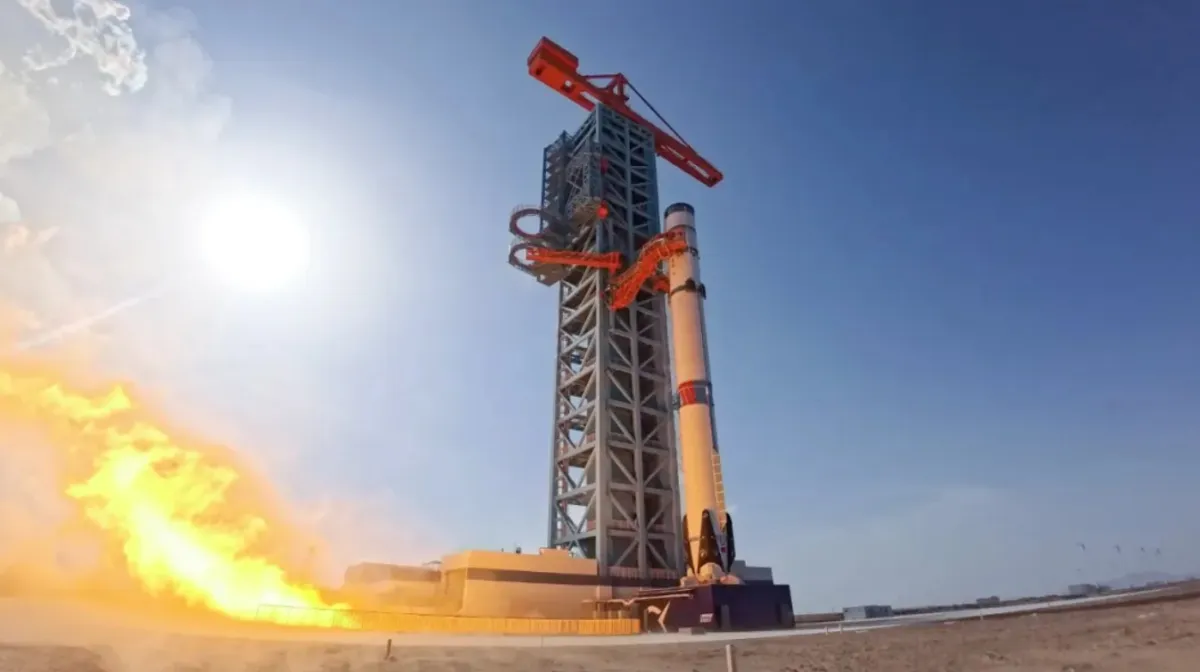
Hyderabad-based startup Abyom SpaceTech and Defence has achieved a major milestone in India’s private space sector. The company successfully completed India’s first fully in-house reusable liquid rocket engine qualification test campaign. This achievement places the young startup among a new group of Indian companies that aim to build reusable launch systems for future space missions.
The test took place at Abyom’s own Commercial Test Facility in Hyderabad. The company designed and built the entire system on its own without support from imported infrastructure. This includes the rocket engine, control systems, instrumentation, testing setup, and data systems.
The success marks an important moment for India’s growing private space industry. Until now, reusable rocket development mostly stayed within large global space agencies and a few major companies. Abyom now joins the race with its own reusable propulsion technology.
A Big Step for India’s Space Sector
Reusable rockets have become one of the biggest goals in modern space technology. Traditional rockets usually burn up or fall into the ocean after one launch. Reusable systems allow parts of the rocket to return safely and fly again. This method lowers launch costs and improves mission frequency.
Abyom believes reusable rockets may help India reduce launch expenses and compete more strongly in the global commercial space market. The company also sees major opportunities in defence and strategic applications.
The startup says this successful campaign supports its larger reusable rocket programme called HOPE, short for Highly Optimised Propulsion Engineering. The project also supports development of the company’s Flight Ready Cryogenic Engine programme.
What Happened During the Test
The recent campaign focused on Abyom’s BSE-II reusable liquid rocket engine. Engineers carried out several hot-fire tests to check whether the engine could handle real operating conditions.
According to reports, the engine operated at nearly 12 bar chamber pressure while temperatures crossed 2200 degrees Celsius. The tests also checked key systems such as ignition, injection control, throttling, and fuel mixing.
The company confirmed stable combustion during the tests. Engineers also observed expected plume behaviour and Mach diamond formations during engine firing, which showed correct exhaust performance.
These tests matter because reusable rockets need engines that can restart, throttle, and survive repeated missions. A small mistake in propulsion systems may destroy an entire mission. That is why rocket engine testing remains one of the hardest parts of space technology.
Entire System Built In-House
One of the biggest highlights of the achievement comes from the fact that Abyom built the entire testing ecosystem on its own. Founder and CEO Jainul Abedin described the test as proof of a fully indigenous reusable propulsion ecosystem built inside India.
The startup says it did not depend on imported infrastructure for the project. Its engineers handled engine systems, software, control architecture, instrumentation, and testing procedures internally.
This approach gives the company full ownership of its data and systems. It also allows faster development because engineers can quickly modify and test designs without outside dependence.
The Commercial Test Facility itself forms an important part of the company’s future plans. Abyom says the platform may later support commercial testing services for universities, startups, and research groups.
The Vision Behind Abyom
Abyom SpaceTech and Defence began with a strong vision to make space access reusable, reliable, and affordable. Founder Jainul Abedin started the company after years of interest in rockets and space exploration. The company later grew from BITS Pilani Hyderabad campus into a serious player in India’s deep-tech ecosystem.
The name “Abyom” comes from the Sanskrit word “Vyom,” which means sky or space. The startup focuses on reusable rockets with re-ignitable and throttleable cryogenic engines.
Cryogenic engines use super-cooled fuel and remain among the most advanced propulsion systems in aerospace. These engines offer high efficiency but require extremely precise engineering. Only a few nations and companies have mastered such systems.
Abyom wants to create rockets that can support multiple launches within short periods. The company says this approach may lower costs and increase launch availability for future customers.
India’s Private Space Race Grows Faster
India’s private space sector has expanded rapidly over the last few years. Government reforms opened the sector to startups and private investment. Since then, several companies have entered launch services, satellite systems, and propulsion technology.
Companies such as Skyroot Aerospace and Agnikul Cosmos already achieved major milestones in private rocket development. Skyroot became the first Indian private company to launch a rocket into space in 2022. Agnikul later gained attention for its 3D-printed rocket engines and private launch infrastructure.
Abyom now adds another achievement to this growing list through reusable propulsion technology.
Experts believe reusable systems may become the next major phase of India’s commercial space industry. Lower launch costs could help India attract more satellite customers from around the world.
Why Reusable Rockets Matter
Rocket launches remain expensive because many parts get used only once. Reusable systems reduce waste and lower mission costs over time. Companies like SpaceX already proved that reusable boosters can change the economics of space travel.
India also works on reusable launch systems through ISRO’s Reusable Launch Vehicle Technology Demonstration Programme. The national programme studies technologies for future reusable spacecraft and launch vehicles.
Private companies like Abyom now aim to bring similar concepts into commercial markets. If successful, reusable launch systems may support satellite deployment, defence missions, scientific research, and even future human spaceflight projects.
Abyom believes its technology may support both civil and strategic applications. The startup also hopes reusable rockets will improve launch frequency and mission flexibility.
What Comes Next
Abyom now plans to continue development of its reusable launch vehicle and cryogenic engine systems. The company aims to demonstrate a vertical takeoff and vertical landing prototype in the future.
The startup says it has already completed more than 150 tests across different systems and technologies. Future milestones may include larger engines, integrated launch systems, and eventual orbital missions.
The recent success gives Abyom stronger visibility in India’s fast-growing space ecosystem. It also shows how young startups now play an important role in advanced aerospace development.
As India pushes deeper into commercial space technology, reusable rocket systems may become one of the country’s most important future strengths. Abyom’s latest achievement marks another step toward that goal.
Also Read – Why Every Startup Founder Suddenly Wants Blinkit Sales