
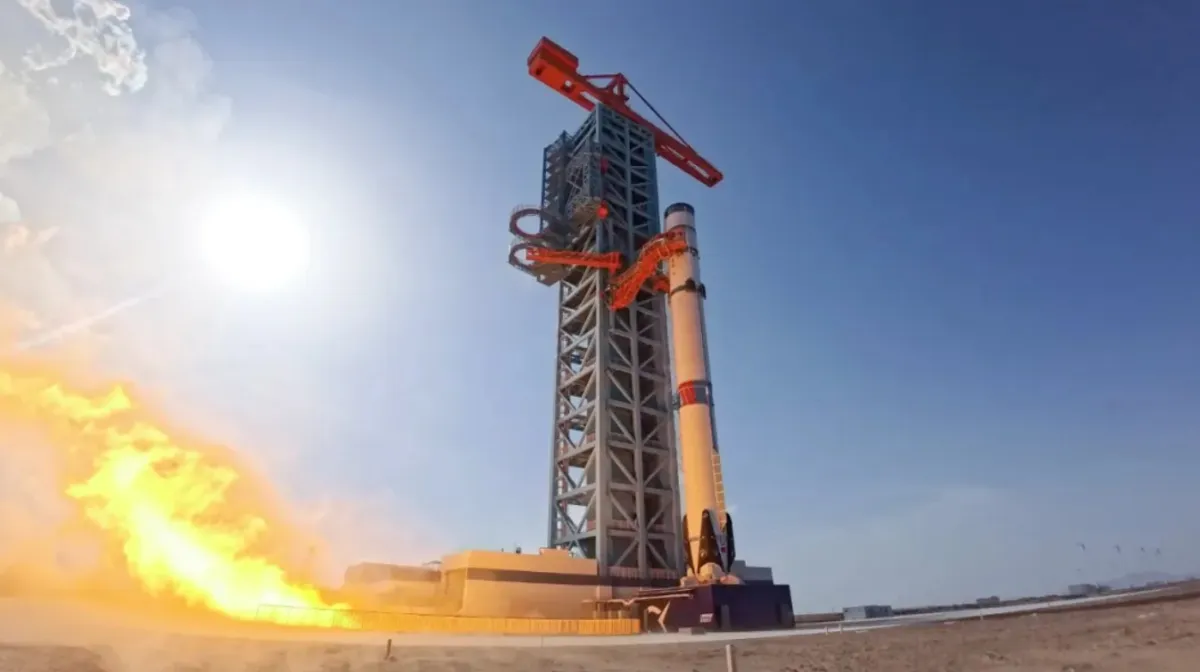
LandSpace captured global attention on December 3, 2025, when the company launched the first flight of its heavy-lift reusable rocket, Zhuque-3. The mission reached orbit successfully, but the rocket’s booster crashed during its landing attempt. The outcome created a wave of reactions across the aerospace world. Supporters admired the company’s ambition, while critics pointed out the technical hurdles ahead.
LandSpace continues to move forward with confidence, and the company’s actions signal a new era for China’s private space industry. The Zhuque-3 mission shows how aggressively Chinese startups now challenge global leaders in reusable rocketry.
LandSpace Builds Its Foundation Through Relentless Experimentation
The company started in 2015, soon after China opened its space sector to private investment. LandSpace entered the industry with limited experience, but the founders embraced experimentation and rapid learning.
The company launched its first rocket, Zhuque-1, in 2018. That mission failed to reach orbit because the third stage malfunctioned, but LandSpace treated the setback as a valuable learning step rather than a defeat. The team analyzed the problem, redesigned components, and shifted their focus toward more advanced engines.
Next, the company designed Zhuque-2, a methane-oxygen rocket that demonstrated far greater capability than its predecessor. In 2023, Zhuque-2 reached orbit and became the world’s first methane-powered rocket to achieve that milestone. The success placed LandSpace ahead of several established global players who still tested methane engines on the ground.
The company then improved Zhuque-2, developed the ZQ-2E version, and completed commercial missions throughout 2024 and 2025. During that period, LandSpace also built a large-scale manufacturing facility for liquid-fuel engines and rocket stages. The company’s strategy depended on rapid iteration, tight feedback loops, and heavy investment in in-house technology.
Zhuque-3 Marks LandSpace’s Ambition to Join the Global Elite
LandSpace developed Zhuque-3 to compete directly with the world’s most advanced reusable rockets. The company designed the vehicle to deliver heavy payloads at significantly reduced costs.
Here’s what sets Zhuque-3 apart:
1. Reusable First Stage
LandSpace designed Zhuque-3’s first stage to return to Earth, reignite its engines, and land vertically. The rocket uses nine Tianque-12A methane engines, and five of those engines provide gimbal control for precise navigation during descent.
2. High Payload Capacity
The rocket lifts 20–25 tons into low Earth orbit, several times more than Zhuque-2. That capability allows LandSpace to attract satellite-constellation operators, commercial firms, and national agencies that need heavy-lift services.
3. Drastic Cost Reduction
By recovering and reusing the booster stage, the company aims to reduce launch costs by more than 80 percent. Reusability gives the startup a competitive advantage in a market where payload operators demand inexpensive and frequent launches.
4. Alignment With China’s Satellite Ambitions
China plans to deploy enormous broadband and Earth-observation constellations. Reusable rockets provide the launch frequency and affordability that these constellations require. Zhuque-3 strengthens China’s long-term strategic infrastructure.
5. A Direct Challenge to Global Leaders
LandSpace wants to stand alongside SpaceX and Blue Origin. Zhuque-3 represents China’s closest attempt so far at a rocket that directly challenges the Falcon 9 and New Glenn in capability and cost efficiency.
December 3 Flight: Success in Orbit and Failure in Recovery
On December 3, 2025, LandSpace launched Zhuque-3 for the first time. The rocket climbed through the atmosphere, ignited its second stage, and delivered its payload into orbit. The team celebrated the orbital achievement because the mission demonstrated the rocket’s raw lifting power and engine reliability.
However, the recovery attempt created a dramatic turn. The booster began its descent normally, adjusted its trajectory, and prepared for the final landing burn. Moments before touchdown, the engines suffered an “abnormal combustion event.” The booster lost control and crashed instead of landing upright.
LandSpace released a brief statement and acknowledged the failure. The company started a full investigation immediately. Engineers collected telemetry, camera footage, and engine data to identify the cause of the combustion irregularity. The leadership team emphasized improvement and optimization rather than blame.
Although the booster crashed, the mission still advanced LandSpace’s overall goals. The rocket achieved orbit, the engines proved their power, and the company collected real-world recovery data that will influence future designs.
How This Mission Shapes the Global Rocketry Landscape
Zhuque-3’s first mission carries significance far beyond LandSpace itself.
1. The Reusable-Rocket Race Intensifies
Only a few companies in the world have attempted orbital-class reusable boosters. SpaceX stands at the front with decades of experience. Blue Origin continues to refine its reusable systems. Now, LandSpace has entered the same arena with a rocket that can challenge global standards.
The December 3 launch tells the world that more players now chase the same goal. As new companies succeed, launch prices will fall, innovation cycles will accelerate, and the entire space economy will expand.
2. China’s Private Space Sector Gains Credibility
For many years, China’s state-led space program dominated headlines. Private companies rarely contributed to major milestones. LandSpace changes that narrative. The startup now demonstrates that Chinese private-sector innovation can support large-scale rocket development.
This shift will attract more investment, more engineering talent, and more competition within China’s commercial space ecosystem.
3. The Mission Fuels China’s Satellite Plans
China continues to prepare its competing response to Starlink and other global constellations. Zhuque-3 will offer cheap and fast launch cycles for these projects. Even with the landing failure, the mission strengthens confidence in China’s long-term space ambitions.
4. Other Global Players Feel Renewed Pressure
An emerging Chinese competitor increases pressure on U.S., European, and Indian commercial launch companies. LandSpace’s progress will push everyone to accelerate timelines and innovate aggressively.
LandSpace’s Next Strategic Moves
LandSpace now stands at a crucial turning point. The company plans the next steps carefully.
1. Engineers Analyze the Booster Crash
The team studies the combustion issue that destroyed the booster. They examine engine behavior, fuel-flow patterns, and nozzle conditions. They want to locate the exact cause and redesign the system to prevent similar failures.
2. The Team Prepares for the Next Launch
LandSpace intends to attempt a second Zhuque-3 launch after resolving the engine issue. The company wants to demonstrate a reliable recovery sequence, and management views successful recovery as essential for market confidence.
3. The Company Seeks New Partnerships
Satellite operators, government agencies, and private firms now observe Zhuque-3 closely. LandSpace wants to convert that interest into long-term contracts.
4. The Company Plans Aggressive Expansion
LandSpace already invested in advanced facilities. Leadership wants to expand engine production lines, improve testing sites, and scale launch operations to handle multiple missions per month.
Conclusion: A Single Landing Failure Cannot Slow LandSpace’s Momentum
LandSpace delivered a powerful message with the Zhuque-3 mission. The company reached orbit with a heavy-lift rocket that it developed independently. The booster crash revealed technical challenges, but the result never weakened LandSpace’s resolve. Instead, the company now moves with more urgency, more confidence, and more determination.
LandSpace now stands at the front of China’s private aerospace industry, and the Zhuque-3 program positions the company as a serious global competitor. The next attempt will capture even more global attention, and a successful booster recovery will permanently shift the competitive landscape.
Also Read – Neutrinos Launches a Venture Studio to Accelerate BFSI Startups