
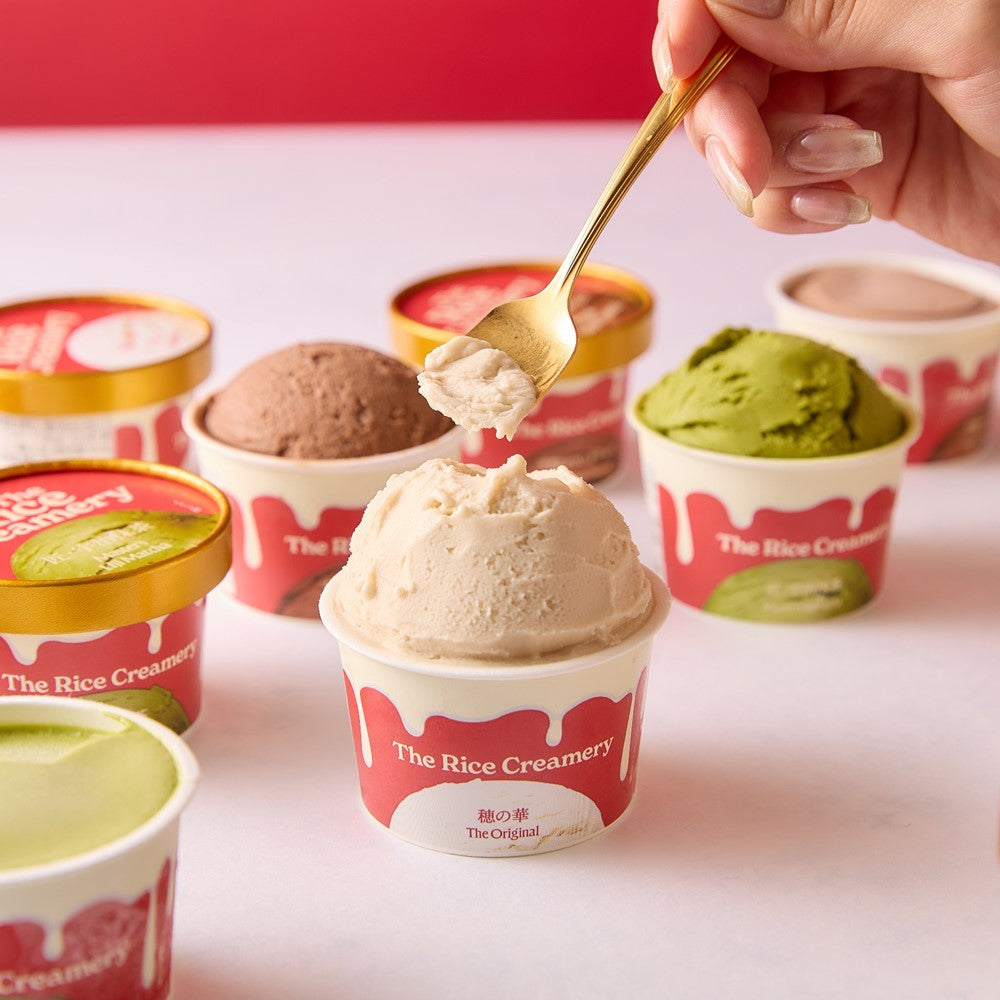
Japanese food tech company Kinish has unveiled a new plant-based ice cream brand that puts rice in the spotlight. Called The Rice Creamery, the range ditches dairy and focuses on the natural sweetness and texture of Japanese rice.
The launch marks a major step for the Tokyo-based startup, which not only wants to create new rice-based treats but also aims to transform dairy alternatives through advanced molecular farming. Kinish plans to take its rice ice cream global, with a U.S. debut in Washington, D.C. later this year under The Rice Cream brand, reported by Green Queen.
A New Take on Vegan Ice Cream
Kinish’s new range features three flavours — Honoka (Original), Master’s Uji Matcha, and Elegant Dutch Chocolate. Instead of replicating the taste of milk, the brand celebrates the unique qualities of Japanese rice.
The rice varieties used are naturally sweet, short, plump, and sticky. This allows the ice cream to deliver a creamy texture and a layered flavour profile that even dairy-based ice creams can’t always match.
The products are 60% lower in sugar than the average ice cream in Japan, and reduce greenhouse gas emissions by 62% compared to conventional dairy products. This makes them attractive to consumers who are increasingly aware of both nutrition and climate impact.
Flavours with a Story
- Honoka – The original flavour combines rice syrup with cashew paste, plus sugar, glucose, dietary fibre, salt, an emulsifier, and a stabiliser. It’s simple, creamy, and highlights rice’s natural sweetness.
- Master’s Uji Matcha – A collaboration with tea processor Hotta Katsutaro Shoten, this variant blends the rice-cashew base with premium Uji matcha, offering a rich, earthy taste.
- Elegant Dutch Chocolate – A nod to Japan’s introduction to chocolate by the Netherlands, this flavour uses Dutch cocoa powder for a deep, satisfying chocolate profile.
Each tub is priced at ¥347 ($2.35) and is currently available at the Tokyu Store’s Toritsu-Daigaku branch and online via Seijo Ishii. Expansion into convenience stores and major cities across Japan is planned.
Positive First Impressions
Before the official launch, Kinish held public taste tests. The feedback was overwhelmingly positive, with comments like:
- “It’s satisfyingly delicious.”
- “It’s rich and flavorful, yet leaves a pleasant aftertaste.”
These reactions suggest the brand has successfully positioned itself as more than just a vegan alternative — it’s a premium dessert in its own right.
Why Rice, and Why Now?
Kinish’s timing is strategic. Dairy farming is facing economic and environmental challenges in Japan. The carbon footprint of dairy is more than twice that of rice, and the number of dairy farmers has been declining for decades. Meanwhile, milk consumption has dropped since the 1990s.
There’s also a clear market need for alternatives: up to 90% of Japan’s population is lactose-intolerant, and veganism, while still niche, has been growing steadily — from 1% of the population in 2017 to 2.4% in 2023.
Rice, on the other hand, is culturally significant and widely grown. By reimagining it for modern food products, Kinish is tapping into both tradition and innovation.
A Niche but Growing Category
Rice-based ice cream alternatives are rare. In Japan, Morinaga Company sells two under its Okometo brand, while in Singapore, Smoocht offers brown-rice-based ice creams. This means Kinish is entering a relatively open market segment, with the potential to define it.
The company’s approach is also unique — instead of just making plant-based ice cream, it is developing rice as a platform for dairy protein production through molecular farming.
Molecular Farming: The Bigger Vision
Kinish’s ice cream launch is just one part of its bigger mission: producing casein — the main protein in cow’s milk — inside rice plants. Casein is vital for replicating the functional and sensory properties of dairy in products like cheese and yoghurt.
To do this, Kinish uses molecular farming, a process where plants are genetically engineered to produce specific animal proteins. Instead of costly fermentation tanks, the plants themselves become the “bioreactors,” making the process potentially more scalable and cost-effective than precision fermentation or cell cultivation.
Kinish grows dwarf rice plants that are only 20 cm tall in vertical farms, allowing high-density cultivation with less land and water. Crops can be harvested in less than half the time required for traditional rice farming.
Collaborations and Funding
Earlier this year, Kinish partnered with Shizuoka University to design a plant factory specifically for dwarf rice production. It also raised ¥120 million ($800,000) in seed funding in February to accelerate its research and expand production capacity.
This funding supports both the ice cream rollout and the company’s molecular farming R&D, creating a mutually reinforcing business model where the consumer product helps fund the technology, and the technology will eventually improve the product.
Climate and Agricultural Pressures
Japan’s rice sector is under stress from climate change. Rising temperatures and unpredictable weather patterns have already affected yields. In fact, rice consumption in Japan has dropped by more than half since the 1960s. Recently, a shortage forced the government to release 200,000 tonnes from its emergency stockpile.
By growing rice indoors in controlled environments, Kinish reduces dependence on outdoor farming conditions, while also creating new economic opportunities for rice cultivation.
Competition in Protein Innovation
Kinish is one of several startups globally working on molecular farming for dairy proteins:
- Alpine Bio, Mozza, Miruku, Veloz Bio, and Finally Foods are all pursuing casein in plants.
- New Culture, Fermify, Zero Cow Factory, Standing Ovation, and Those Vegan Cowboys are developing casein via precision fermentation.
- Pureture is making vegan casein from yeast through liquid fermentation.
What sets Kinish apart is its integrated approach — using rice as both the protein host and the sensory base for consumer products.
The Road Ahead
Kinish’s next step is to combine its rice-derived casein with rice starch to create a truly dairy-like ice cream. Beyond that, it plans to develop cheese products using the same milk protein, further expanding its dairy-alternative portfolio.
The U.S. launch will be a critical test of the brand’s international appeal. Washington, D.C., with its diverse, health-conscious consumer base, offers a good starting point for market entry. Success there could pave the way for expansion into other cities and regions.
A New Chapter for Rice-Based Foods
Kinish is blending cultural heritage, cutting-edge science, and sustainability in a way few food companies have attempted. By starting with something as universally loved as ice cream, it has a tangible, tasty way to introduce consumers to its broader vision.
If the brand can scale production, maintain quality, and win over both domestic and international markets, it could help make rice-based dairy alternatives a mainstream category — and offer a blueprint for how staple crops can be reimagined for a climate-conscious future.
Also Read – Why Google Makes It Harder for Businesses to Rank