
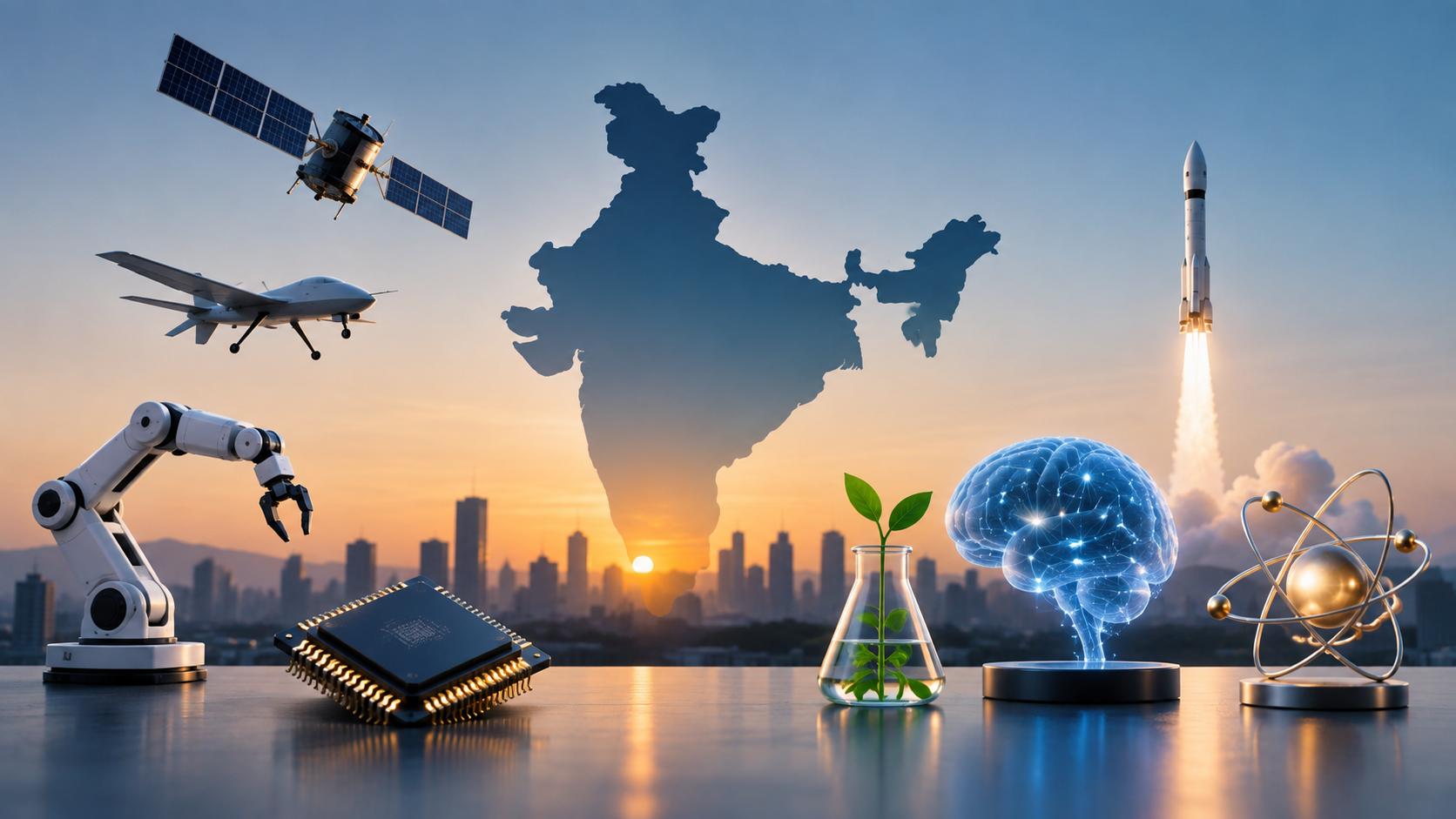
India’s deep-tech startup sector has entered a new phase in 2026. The market now shows stronger interest in companies that build hard technology, rather than only software products. Artificial intelligence, semiconductors, space technology, defence systems, robotics, biotech and quantum technology now form the core of this shift.
The funding numbers show the change clearly. Indian deep-tech startups have raised about $2.3 billion across around 200 deals in 2026 so far, according to Tracxn data reported by Mint. That figure already stands above the $1.62 billion raised across 453 deals during the whole of 2025. The higher capital total, despite fewer deals, points to larger cheques and greater investor focus on companies with strong technology and scale potential.
IVCA estimates that Indian deep-tech companies have raised $11.4 billion since 2015. More than 85% of that capital came during the past six years. The rise shows how quickly deep tech has moved from a small part of the startup market toward a major area of technology investment.
Seven areas stand out in 2026. Each one has a different path to growth, but all have a strong link with India’s technology, defence, industrial and national infrastructure goals.
1. Sovereign AI and AI Infrastructure
Artificial intelligence now sits at the centre of India’s deep-tech story. The focus has also moved beyond simple AI applications. Indian companies now target foundation models, AI infrastructure, specialised models, sovereign computing and large-scale enterprise use.
Sarvam AI provides one of the clearest examples. The company announced a $300 million Series B round in June 2026. The first close brought $234 million at a $1.5 billion post-money valuation. HCLTech invested $150 million in that round.
Sarvam has also reported more than 10 million API calls each day. Its conversational platform handles more than 2 million interactions each day. Those numbers show a move from research and early products toward large commercial use.
AI infrastructure also has a major role in this market. Yotta now targets a January–March 2027 IPO of up to $1.5 billion. The company plans to use part of the proceeds for GPUs and sovereign cloud expansion.
The larger question for Indian AI startups now concerns technology depth. Low-cost access to AI alone may not create a strong global company. Indian firms need their own models, infrastructure, data advantages or specialised technology that can compete outside the domestic market.
Sarvam AI, Neysa, Krutrim, Ema, Gnani and other AI infrastructure companies therefore deserve close attention through 2026.
2. Semiconductors and Chip Design
Semiconductors may become one of the most important deep-tech sectors for India. The country has spent years building software talent, but chips require a very different industrial base. That base now has much stronger government support.
India has notified Semicon 2.0 with about ₹1.27 lakh crore in government support. The programme goes beyond chip factories. It covers chip design, semiconductor equipment and materials, fabs, advanced packaging, research and development and talent.
The government also wants to create another 100,000 semiconductor engineers. That target matters for startups that need specialised technical talent rather than general software developers.
This new policy creates space for companies across the semiconductor value chain. Chip architecture, fabless design, electronic design automation, power semiconductors, photonics, materials, testing and advanced packaging can all gain from this push.
Mindgrove, Signalchip, Agnitron, Morphing Machines and InCore Semiconductor stand among the companies worth watching. More startups may also emerge around semiconductor materials, equipment and specialist chip design.
The bigger change comes from the wider approach. India no longer focuses only on factories. The country now aims to build a complete semiconductor ecosystem.
3. Space Technology and Orbital Infrastructure
India’s private space sector has made a major jump in a short period. The country had almost no private space startup base in 2014. By 2026, the ecosystem has more than 400 companies and around $600 million in cumulative private investment.
The sector also has a much wider scope than rocket launches. Skyroot Aerospace works on launch vehicles. Pixxel focuses on hyperspectral Earth observation. Agnikul Cosmos develops 3D-printed rocket engines. Digantara works on space situational awareness. GalaxEye develops Earth observation technology. Dhruva Space works on satellite infrastructure, while SatSure focuses on satellite intelligence.
Pixxel and Sarvam AI also announced a major 2026 partnership. The two companies plan to develop India’s first orbital data-centre satellite. The proposed 200-kg-class Pathfinder could run AI inference in orbit and may launch as early as the fourth quarter of 2026.
Such projects show how space technology can move into new areas. Satellites can provide data, computing, communication and intelligence instead of serving only as transport platforms.
The next test will come from business scale. Rocket launches and satellite missions can create strong headlines, but repeat revenue will determine which companies can become lasting global businesses.
4. Defence Technology, Drones and Autonomous Systems
Defence has become another major market for Indian deep-tech companies. The opportunity now extends well beyond traditional military hardware.
Startups work across autonomous drones, counter-drone systems, battlefield AI, navigation, sensors, secure communication, electronic warfare, robotics and aerospace systems.
Drone technology offers a clear example. India has started to focus more on local production of critical UAV parts rather than simple assembly of complete drones. Flight controllers, sensors, navigation systems and communication equipment now carry strategic value.
Government demand also gives this sector a strong push. India continues to expand domestic defence production while building partnerships with foreign technology companies. A recent example came from Thales and Kalyani, which signed an agreement for 70-mm rocket systems with manufacturing in India.
Companies such as ideaForge, NewSpace Research & Technologies, Tonbo Imaging, Raphe mPhibr and Optimized Electrotech remain worth watching.
Defence startups still face a difficult business path. Government procurement can take years. Product approval also requires strict tests. Companies therefore need enough capital and strong technology to survive long sales cycles before large production orders arrive.
5. Robotics and Physical AI
Artificial intelligence has mostly worked with digital information. The next stage brings AI into the physical world. Robots can see, understand surroundings, make decisions and perform physical tasks. This shift gives robotics a much larger role in India’s deep-tech market.
Deeptech Navigator currently tracks about 4,620 Indian robotics and industrial automation startups. That figure shows the size of the wider ecosystem, although different databases use different definitions for startup categories.
Industrial robots, warehouse machines, humanoids, farm robots, autonomous vehicles, surgical robots and inspection systems all form part of this market. Defence robotics also connects this sector with the country’s wider security needs.
The need for physical-world data creates another new market. Instawork says its India operation targets 20 million hours of robotics-related work in 2026. Robot systems need real-world interaction data to learn tasks, movement and safety rules. Text and image data alone cannot provide that information.
Indian companies such as CynLr, Ati Motors, Addverb, Unbox Robotics and Genrobotics show the range of local work in this field.
The key test for robotics will come from cost and reliability. A robot may show impressive technical performance in a controlled test, but factories and warehouses need machines that can work safely, repeatedly and at a sensible price.
6. Biotech, MedTech and Computational Biology
India’s biotech sector now sits at the point where biology, medicine, artificial intelligence and advanced computing meet. This combination creates new opportunities for diagnostics, drug discovery, medical devices and other health technologies.
Deeptech Navigator lists Health & Life Sciences as India’s largest deep-tech category by funding events. Robotics, mobility and AI follow among the major areas.
AI-based diagnostics have already gained traction. Qure.ai stands out as a major Indian example of AI use in clinical workflows. Other companies such as Bugworks, Eyestem, ImmunitoAI and Nesa MedTech show the wider range of work across biotech and medical technology.
Drug discovery also offers a major opportunity. Machine learning can help researchers study biological data, identify possible drug targets and reduce the time needed for early research. Synthetic biology, cell and gene therapy, biosensors and computational biology add further possibilities.
Government support has also expanded. In April 2026, the government said BIRAC was approaching 200 biotech applications as the wider deep-tech support system grew.
Biotech startups face a different path from software firms. Scientific proof alone does not create a commercial product. Regulatory approval, clinical evidence, manufacturing quality and international market access all matter.
7. Quantum Technology, Photonics and Advanced Computing
Quantum technology remains at an earlier stage than AI, space or semiconductors. Yet India has created a strong national framework for the sector.
The National Quantum Mission has a budget of ₹6,003.65 crore through 2030–31. The mission covers quantum computing, communication, sensing and metrology, as well as quantum materials.
The country has also moved from research toward real-world tests. In April 2026, India reported a 1,000-km quantum-secure communication milestone with technology from QNu Labs. The government also expanded National Quantum Mission support to 17 startups.
Four national thematic hubs now cover major parts of the field. IISc leads the quantum computing hub. IIT Madras and C-DOT lead quantum communication. IIT Bombay leads quantum sensing and metrology. IIT Delhi leads quantum materials and devices.
QNu Labs, QpiAI, BosonQ Psi and QMet are among the companies worth watching.
The near-term opportunity may not come from full-scale quantum computers. Quantum-safe security, advanced sensing, photonics and quantum materials may reach commercial markets sooner.
Funding Shows a Stronger Deep-Tech Market
The funding trend adds another important layer to the story. Indian deep-tech startups raised $2.9 billion across 189 rounds in 2025, according to IVCA data reported by Business Standard. The 2026 numbers now show about $2.3 billion across around 200 deals so far.
The difference in deal size matters. The market now has fewer signs of broad startup speculation and more signs of capital concentration around companies with serious technical assets.
A group of eight US and Indian investors also announced a $1 billion-plus alliance in 2025 for Indian deep-tech startups over the following decade. Such commitments can provide companies with longer-term capital for research, product development and scale.
Deep tech requires more time and money than a typical software startup. Hardware needs factories, laboratories, testing and supply chains. Biotech needs trials and regulatory work. Space companies need launch access. Semiconductor firms need specialist tools and facilities. Quantum companies need expensive research infrastructure.
Large capital pools therefore matter more in this sector than they do in many software categories.
What Comes Next for Indian Deep Tech
India’s deep-tech market now has seven strong areas to watch, but three stand out for near-term impact.
Sovereign AI and compute have the strongest commercial momentum. Large funding rounds, enterprise demand and government interest all support the sector.
Space and geospatial intelligence also have a clear path toward global markets. Indian companies now have access to launch infrastructure, satellite technology and large amounts of Earth observation data.
Semiconductors and photonics could create the deepest industrial change. Semicon 2.0 gives startups support across a much wider technology chain, from design to advanced packaging.
Robotics remains the major wildcard. Physical AI could become a huge industrial market if capable robots reach lower prices and higher reliability.
Quantum technology sits further from mass adoption, yet its progress deserves attention. Strong public funding, national research hubs and early startup support can help India build expertise before the global market reaches full scale.
The Indian deep-tech story in 2026 therefore goes far beyond startup funding. It now connects AI with computing, satellites with data, chips with national infrastructure, robotics with factories, biotech with advanced computing and quantum science with secure communication.
The next phase will test execution. Strong research can attract capital, but commercial success needs products, customers, reliable supply chains and global markets. Companies that can cross that gap may define India’s next generation of technology leaders.
Also Read – First 10 Startup Hires: What to Hire and When