
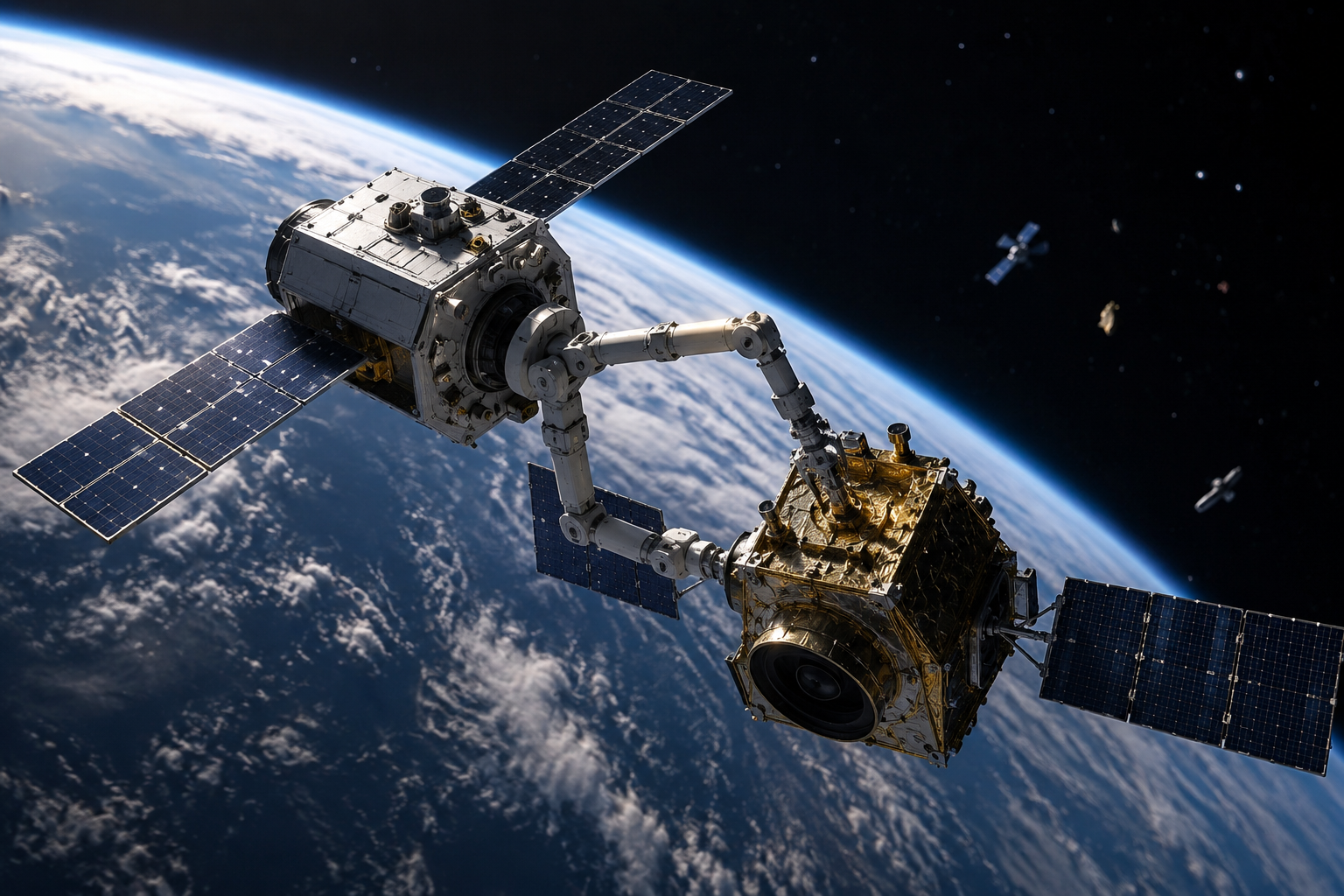
InspeCity, an IIT Bombay-incubated spacetech startup, has raised ₹100 crore, or about $10.5 million, in a Pre-Series A funding round. The company plans to use the new capital to build its in-space servicing platform and prepare for four orbital missions.
The funding marks an important step for the young space company. InspeCity wants to work on technology that can help spacecraft get support after they reach orbit. This area is gaining attention across the global space sector, as more satellites enter orbit and operators look for ways to keep them useful for longer periods.
The new capital gives InspeCity more room to build its technology, test its systems and prepare for its next set of missions. Its focus on four orbital missions also gives the company a clear path from development to real-world use.
A New Kind of Space Service
Most space missions have a simple model. A rocket carries a satellite into space, the satellite starts its work and the operator manages it from the ground. If the spacecraft faces a major problem in orbit, there are very few ways to fix it.
In-space servicing aims to change this model.
A service spacecraft can travel to another spacecraft after both are in orbit. It may inspect the satellite, move it to another orbit or help extend its useful life. In more advanced cases, such systems may support repair or refuel tasks.
This idea could become important as the number of satellites in space grows. Satellite operators spend large sums to build and launch spacecraft. If a satellite can stay useful for a longer period, its operator may get more value from that original investment.
InspeCity wants to build technology for this future market.
The IIT Bombay Connection
InspeCity comes from the startup ecosystem around the Indian Institute of Technology Bombay. IIT Bombay has a strong record in science, engineering and technology research, which has helped create a wider base for deep-tech startups.
For a spacetech company, such a background can be useful. Space hardware needs strong engineering skills, careful testing and long development cycles. A company also needs access to people who can work across areas such as spacecraft systems, software, control systems and mission operations.
InspeCity’s connection with IIT Bombay gives it a strong technology base as it works toward its orbital goals.
The latest funding can now help the company take its work to a larger scale.
Why In-Space Servicing Matters
The space sector is changing fast. There are now far more satellites in orbit than in the early years of the space age. Many of them support communication, navigation, weather services, Earth observation and other important work.
At the same time, sending a new satellite into orbit remains costly. A satellite also takes years of design and testing before launch.
This creates a simple business question: what if a satellite does not need to be replaced every time it needs help?
An in-space service could offer another option.
For example, a service spacecraft could inspect a satellite and help an operator understand its condition. It could also assist with a change in orbit or other tasks that would otherwise require a new mission.
The exact services depend on the technology a company develops. However, the wider goal is clear: make space assets more flexible and useful after launch.
Four Orbital Missions Ahead
One of the most important parts of InspeCity’s plan is its preparation for four orbital missions.
These missions can help the company prove that its systems work outside a laboratory. Space presents conditions that are difficult to copy on Earth. A spacecraft must operate without direct physical access from engineers. Its systems need to work with high reliability, since even a small fault can threaten an entire mission.
Orbital missions can provide valuable lessons in spacecraft control, communication, navigation and mission operations.
For InspeCity, the four missions may also help build confidence among future customers and partners. A successful space mission can show that a company’s technology is ready for commercial use.
What the ₹100 Crore Can Change
A Pre-Series A round of ₹100 crore gives InspeCity a much larger financial base for its next phase.
Space companies usually need substantial capital because hardware costs are high. Development also takes time. Teams must build components, test them, deal with failures and make changes before a spacecraft is ready for launch.
The new funds can support this process as InspeCity develops its in-space servicing platform and prepares its orbital missions.
The money can also help the company expand its team and strengthen its engineering work. More capital gives a deep-tech startup greater ability to plan beyond a single prototype and work toward a complete product.
That is important in space, where a successful business often needs several years of technical development before it can reach a large commercial market.
A Chance to Build Space Infrastructure
InspeCity’s ambition goes beyond one spacecraft or one mission. Its focus on in-space servicing points toward a wider role in the space economy.
If its technology works well, the company could eventually serve satellite operators that need help with assets already in orbit. Such a model could create a new type of space infrastructure.
The idea is similar to how support services work in other industries. A customer does not always need to replace an expensive asset. Sometimes a specialist service can help maintain, move or extend its use.
Space has had very few such options. That could change as service spacecraft become more capable.
Challenges Remain
The opportunity is large, but the technical challenge is also serious.
A spacecraft that needs to approach another object in orbit must operate with great accuracy. Relative speed, position and direction all matter. A small error during a close approach can cause a major accident.
The company must also prove that its systems can work for long periods in the harsh space environment. Radiation, extreme temperatures and limited access to hardware make space missions far harder than most Earth-based technology projects.
There are also commercial challenges. A strong technology alone does not guarantee a large business. InspeCity will need customers that see enough value in its services to pay for them.
The four planned orbital missions will therefore be important not just as technical tests, but also as proof of the company’s wider business case.
India’s Growing Spacetech Sector
InspeCity’s funding comes at a time when India’s private space sector has gained more attention.
Indian startups now work across several areas, from launch systems and satellite technology to Earth observation and space-based services. Greater private participation has created new opportunities for companies that once had limited paths into the space market.
For India, companies that develop advanced space technology can also have value beyond their own commercial success. They can create skilled jobs, build local supply chains and develop technologies that may find customers in other countries.
InspeCity’s focus on in-space servicing gives it a place in one of the more advanced parts of this growing sector.
What Comes Next for InspeCity
The ₹100 crore Pre-Series A round gives InspeCity the resources to enter its next stage.
Its immediate focus is clear: develop its in-space servicing platform and prepare for four orbital missions. The results of those missions will tell the market how close the company is to its larger goal.
Success could give InspeCity a strong position in a market that may become much bigger as satellite numbers rise. It could also help prove that Indian spacetech startups can build complex systems for use beyond Earth’s atmosphere.
For now, the company has a demanding road ahead. Four orbital missions, advanced spacecraft technology and the search for commercial customers will all test its capabilities.
But with ₹100 crore in fresh Pre-Series A capital and a clear focus on in-space services, InspeCity has taken a major step toward its ambition of making space more serviceable, flexible and useful.
ALSO READ: Groww Wins Startup of the Year at ET Startup Awards 2026