
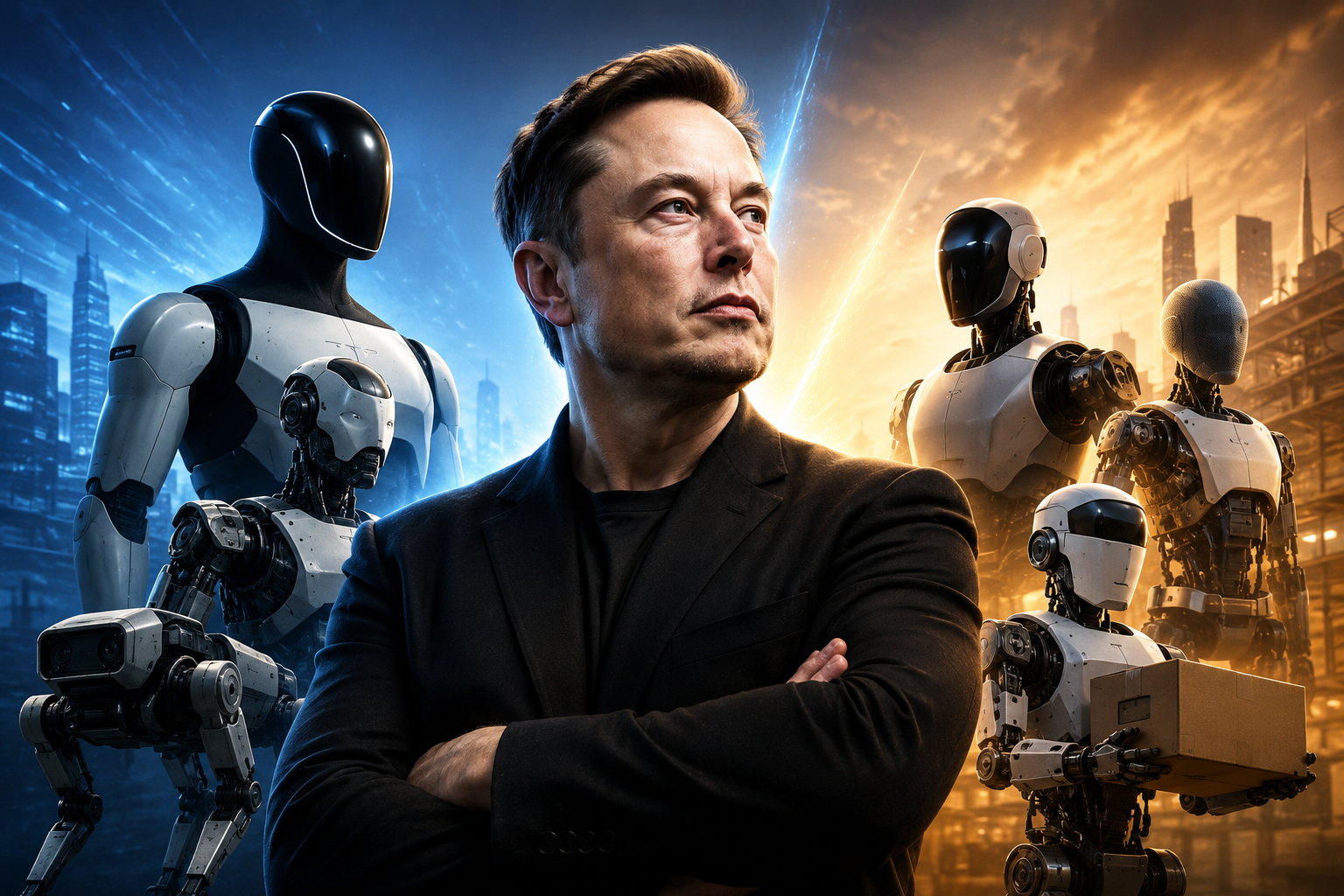
For the last few years, the world saw artificial intelligence mostly through chatbots and software tools. Companies like OpenAI, Google DeepMind, and Anthropic led this race with systems that could answer questions, write content, and solve problems. But now, the focus has started to shift in a very different direction.
The next major battle in technology is not about software alone. It is about machines that can understand the real world and physically interact with it. Experts now call this new field Physical AI. This type of AI allows robots and machines to see objects, make decisions, and complete real-world tasks without constant human control.
This new race has become one of the most important battles in the technology industry, and Elon Musk stands right in the center of it.
Elon Musk’s Massive Bet on Physical AI
Elon Musk believes robots will become one of the biggest industries in human history. Through Tesla, he has invested heavily in a humanoid robot called Optimus, a machine built to perform tasks that humans usually do every day.
Musk believes billions of robots could one day replace human labor in factories, warehouses, offices, and even homes. He has openly stated that Tesla’s robot business could eventually become bigger than its electric car business.
For Tesla, this is far more than a side project. Musk sees Optimus as a product that could completely change the company’s future and create a new global market worth trillions of dollars.
But Tesla no longer stands alone.
Figure AI Has Quietly Become Tesla’s Biggest Threat
One company that has suddenly entered the spotlight is Figure AI. While Tesla receives most of the public attention, Figure AI has quietly built strong momentum behind the scenes.
The startup has raised billions of dollars and secured partnerships with major logistics companies. Its robots already perform tasks such as package sorting inside warehouse environments.
What makes Figure AI dangerous for Tesla is speed. Instead of building public hype, the company focuses directly on commercial use. It wants real customers and real deployments rather than long-term promises.
Many industry experts now believe Figure AI may become one of Tesla’s strongest competitors in the humanoid robotics market.
Physical Intelligence Focuses on Robot Brains
Another startup called Physical Intelligence has taken a completely different path. Instead of building robots themselves, the company focuses on the intelligence systems that power robots.
Its technology helps robots learn tasks without repeated training. In simple terms, this means a machine could watch a human complete a task once and then understand how to repeat that action on its own.
This approach could become extremely powerful because the same intelligence system may work across different robot types. While Tesla builds the robot body, Physical Intelligence works on the robot brain.
This has made the startup one of Silicon Valley’s most closely watched AI companies.
Agility Robotics Already Uses Robots in Real Jobs
Unlike companies that still remain in development stages, Agility Robotics already has robots that work in real commercial environments.
Its humanoid robot called Digit was built mainly for warehouse tasks. The machine can move packages and perform repetitive physical work that usually requires human labor.
This gives Agility Robotics a major advantage. Instead of showing future plans, the company already proves that its technology works in actual business operations.
This kind of early deployment creates serious pressure for competitors like Tesla, which still has much work ahead before large-scale rollout.
Boston Dynamics Still Leads in Engineering
When people think about advanced robots, Boston Dynamics often comes to mind first. The company has spent years building some of the most advanced machines ever created.
Its robot called Atlas shows incredible movement, balance, and physical coordination. Many experts still believe Boston Dynamics remains years ahead in robot mobility and engineering quality.
The company now operates under Hyundai and continues development at a fast pace.
Its biggest challenge has always been commercialization. While its technology looks impressive, large-scale business deployment has moved slower compared with newer startups.
Even so, Boston Dynamics remains one of the strongest technical competitors in the robotics industry.
China’s Unitree Robotics Moves Faster at Lower Cost
A company many people underestimate is Unitree Robotics, based in China. While American companies dominate media attention, Unitree has rapidly expanded its robotics business through aggressive development and lower manufacturing costs.
The company produces humanoid robots and robotic systems at prices much lower than many Western competitors.
This creates a major advantage because robotics will eventually depend heavily on affordable production. If companies cannot lower manufacturing cost, mass adoption becomes difficult.
This is where Chinese robotics companies like Unitree could create serious problems for Tesla in the future.
OpenAI Has Quietly Returned to Robotics
OpenAI became famous because of ChatGPT, but many people do not know the company has returned to robotics research after earlier shutdowns.
The company has recently started hiring robotics engineers again and has begun research focused on embodied AI systems. This type of AI helps machines interact with physical environments rather than digital ones.
CEO Sam Altman recently described robotics as one of the most important future directions for artificial intelligence.
If OpenAI successfully combines advanced AI models with robotics systems, it could become a major player in this race.
The Real Competition Is Bigger Than Robots
Many people think this battle is simply Tesla versus other robot companies. But experts say the real competition goes much deeper.
Some companies build robot hardware. Others create the intelligence systems that control robots. Some focus on simulation environments where machines learn tasks before entering the real world.
This means the biggest future winner may not even manufacture robots directly.
The future robotics market has many layers, and success depends on much more than hardware alone.
Nvidia Could Become the Biggest Winner
One company quietly building enormous influence is Nvidia. The company has strongly promoted the idea of Physical AI throughout 2026.
Its strategy focuses on providing powerful computer chips, robot training systems, and simulation platforms that allow machines to learn faster.
CEO Jensen Huang recently said every industrial company will eventually become a robotics company.
Rather than competing with robot makers, Nvidia wants to supply the technology infrastructure behind the entire robotics industry.
This position could make Nvidia one of the biggest winners in the long run.
Why Tesla Could Face Serious Trouble
Tesla still has major strengths. The company has world-class manufacturing systems, advanced vision technology, strong AI engineers, and huge financial resources.
But it also faces major risks.
Optimus remains in early development stages while several competitors already deploy robots commercially. Musk also has a history of overly ambitious timelines that often face delays.
At the same time, specialized robots built for specific jobs may outperform Tesla’s idea of one general-purpose humanoid machine.
This creates uncertainty around Tesla’s long-term leadership.
The Future May Surprise Everyone
Investment in robotics has exploded in recent years. Global robotics funding grew from nearly 4 billion dollars in 2019 to almost 26 billion dollars by 2025.
Experts now believe Physical AI may become a multi-trillion-dollar industry in the future.
Elon Musk has placed a massive bet on Tesla Optimus, but many quiet startups have started moving faster than expected.
The biggest winner in this race may not be Tesla at all.
It could be a lesser-known startup that builds better robot intelligence, cheaper machines, or the infrastructure that powers the next generation of intelligent machines.
The physical AI race has officially begun, and the future leader is still unknown.
Also Read – Smartworks Expands Global Reach With Singapore Deal