
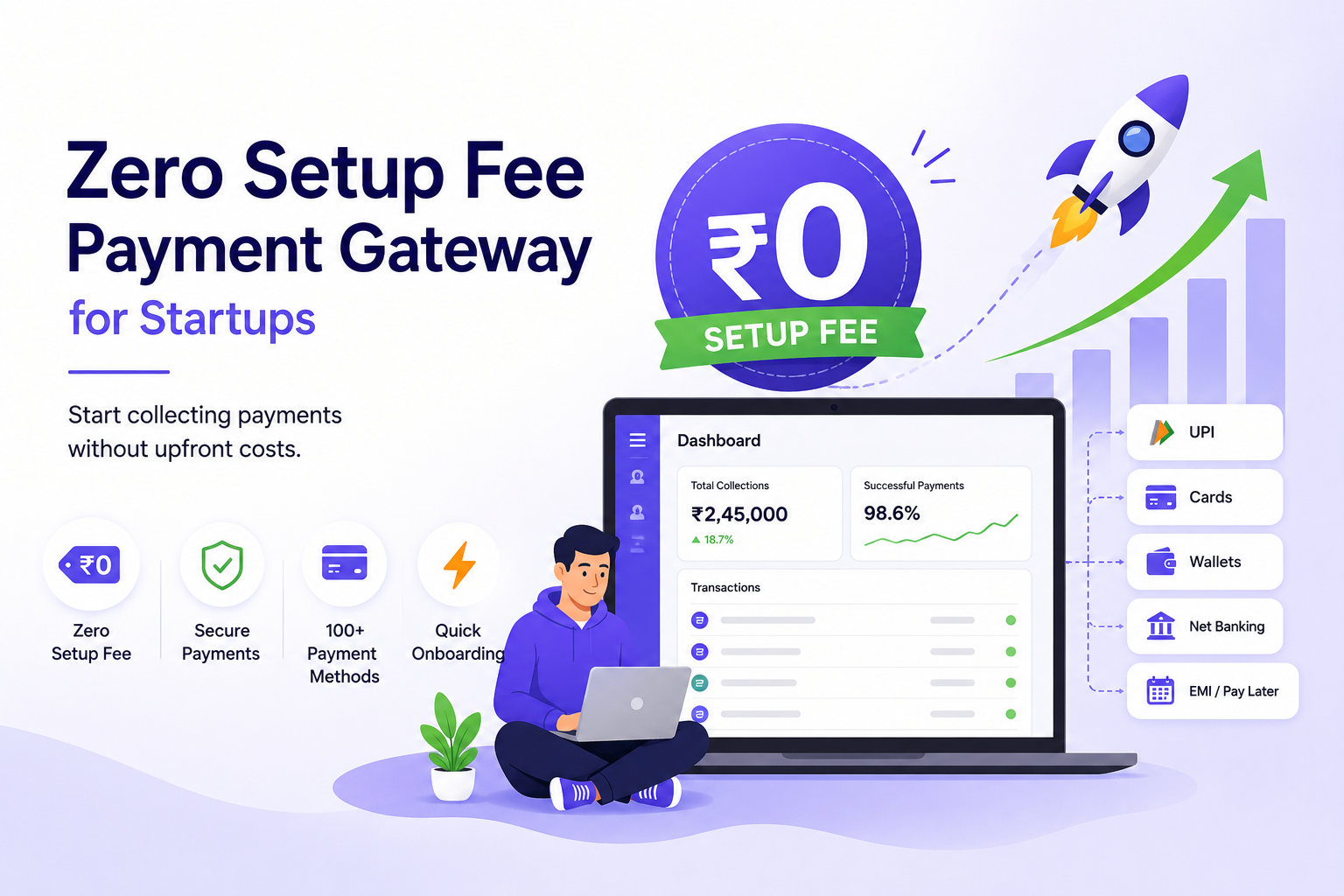
Early-stage startups guard every rupee, and a payment gateway that charges a heavy upfront fee is exactly the kind of cost a young business does not need. The best payment gateways in India now offer zero setup fees, allowing founders to start collecting payments without investing in integration before earning their first sale.
However, zero setup fee is only part of the equation. The real question is how much the gateway costs over time and whether it can reliably support your business as it grows. This guide explains what zero setup fee really means, how to evaluate total payment costs, and what founders should look for before choosing a provider.
TL;DR
- Zero setup fee payment gateways eliminate upfront onboarding costs.
- Startups should evaluate transaction fees, settlement speed, and payment success rates—not just setup costs.
- Hidden charges such as maintenance fees and minimum commitments can significantly increase costs.
- Fast onboarding, broad payment coverage, and reliable settlements are essential for growing businesses.
- The right payment gateway should scale with your startup as transaction volumes increase.
Why Setup Fees Hurt Startups
A setup or integration fee is money spent before any revenue arrives, with no guarantee that the product has even found market fit.
For bootstrapped startups, every rupee matters. Capital is often better spent on:
- Product development
- Customer acquisition
- Marketing experiments
- Hiring key team members
A zero setup fee model removes this barrier and aligns payment processing costs with actual sales. Instead of paying upfront, businesses incur costs only when transactions occur.
This alignment is particularly valuable during the first few months when cash flow and runway are tightly managed.
What Zero Setup Fee Actually Means
Zero setup fee means there is no charge to create an account and integrate the payment gateway.
Many modern providers also eliminate maintenance fees, allowing businesses to keep accounts active without recurring platform costs.
However, startups should remember that payment gateways still charge transaction fees on successful payments. These fees help cover:
- Payment processing
- Security infrastructure
- Fraud prevention
- Regulatory compliance
- System uptime and support
The most important metric is the effective processing cost across your payment mix.
For example, a startup whose customers primarily pay through UPI may have a significantly lower blended payment cost than one that receives most payments through credit cards.
Popular Zero Setup Fee Payment Gateways for Startups in India
Several payment gateways in India offer zero setup fees, making it easier for startups to begin accepting payments without upfront investment. While pricing and features change over time, the following providers are commonly considered by startups:
| Payment Gateway | Setup Fee | Key Highlights |
| Cashfree Payments | ₹0 | 100+ payment methods, high UPI success rates, payment links, subscriptions, payouts, international collections |
| Razorpay | ₹0 | Wide payment acceptance, subscriptions, payment links, developer-friendly APIs |
| PayU | ₹0 | Strong ecommerce presence, multiple payment methods, recurring billing support |
| CCAvenue | ₹0 (select plans) | Large payment method coverage, multi-currency support |
| Easebuzz | ₹0 | Payment links, API integrations, startup-focused solutions |
| Paytm Payment Gateway | ₹0 | Strong wallet ecosystem, UPI support, ecommerce integrations |
How to Choose Among Them
Rather than selecting a gateway solely based on transaction fees, startups should compare:
- Payment success rates
- UPI performance
- Settlement timelines
- Supported payment methods
- Subscription capabilities
- Ease of integration
- Customer support quality
- International payment support
- Scalability as the business grows
For example, a D2C startup may prioritize checkout conversion and payment success rates, while a SaaS company may place greater importance on subscriptions and recurring billing.
A Simple Cost Example
Imagine a startup processing ₹5 lakh in monthly revenue.
Suppose:
- 70% of payments come through UPI
- 30% come through cards
Under a zero setup fee and zero maintenance fee model, the business avoids fixed costs entirely and pays only transaction-based charges.
This approach provides two major benefits:
- No upfront onboarding expenses
- No recurring platform costs during slower months
Compare this with a provider that charges setup fees and annual maintenance fees. Even when sales volumes are low, the startup continues paying fixed costs.
For early-stage businesses, fee structure often matters more than the headline transaction rate.
Reading the Real Cost: What to Watch For
A free start is valuable only if hidden costs do not appear later.
Before selecting a payment gateway, review the following carefully.
Per-Transaction Charges
Payment methods often carry different fees.
Check pricing separately for:
- UPI
- Credit cards
- Debit cards
- Net banking
- Wallets
- EMI options
Your effective processing cost depends on the methods customers actually use.
Recurring Fees
Look for:
- Annual maintenance charges
- Platform fees
- Minimum monthly commitments
- Inactivity fees
A true startup-friendly pricing model should remain predictable as the business scales.
Settlement Speed
Cash flow is critical for startups.
Verify:
- Settlement timelines
- Working-day cycles
- Weekend and holiday treatment
- Visibility into payout reports
Faster and more predictable settlements can significantly improve working capital management.
Refund and Chargeback Policies
Understand:
- Refund costs
- Processing timelines
- Chargeback procedures
- Dispute management support
These become increasingly important as transaction volumes grow.
Beyond Cost: What Makes a Payment Gateway Worth Using?
Pricing is only one part of the decision.
A gateway with lower fees but poor reliability can ultimately cost far more in lost sales.
High Transaction Success Rates
Failed payments directly impact revenue.
Look for providers that offer:
- Smart routing
- Retry mechanisms
- High uptime
- Strong banking partnerships
Even small improvements in payment success rates can have a meaningful impact on conversion and revenue.
Broad Payment Method Coverage
Customers expect flexibility at checkout.
A strong payment gateway should support:
- UPI
- Debit cards
- Credit cards
- Net banking
- Wallets
- EMI options
- Buy Now Pay Later services
The wider the payment coverage, the lower the risk of abandonment caused by missing payment methods.
Fast and Simple Onboarding
Startups often need to move quickly.
Look for providers that offer:
- Digital KYC
- Fast verification
- Simple documentation requirements
- Quick activation
Reducing onboarding friction allows businesses to begin accepting payments sooner.
Scalability
The payment gateway you choose today should still support your business two years from now.
Features that support growth include:
- Payment links
- Subscription billing
- Recurring payments
- Marketplace payouts
- API integrations
- Ecommerce plugins
Switching gateways later can be costly, so scalability should be part of the evaluation process.
Getting Started Quickly
Most startups can begin accepting payments in a few simple steps:
- Create a merchant account
- Complete KYC verification
- Add bank account details
- Choose an integration method
- Test transactions
- Go live
Depending on the provider, businesses may use:
- Ecommerce plugins
- Payment links
- Hosted checkout pages
- APIs and SDKs
For many startups, payment links and ready-made plugins make it possible to start collecting payments on the same day.
Final Thoughts
Zero setup fee payment gateways have made it easier than ever for startups to start accepting digital payments without upfront investment.
However, founders should look beyond setup costs and evaluate the complete picture: transaction fees, settlement speed, payment success rates, onboarding simplicity, and long-term scalability.
The right payment gateway not only helps control costs in the early stages but also supports growth as the business scales. By focusing on both affordability and reliability, startups can build a payment infrastructure that grows alongside their business.
FAQs
Is a zero setup fee payment gateway really free?
There is typically no onboarding fee, but businesses still pay transaction charges on successful payments. The exact cost depends on the payment methods used.
Which payment gateway is best for startups?
The best payment gateway depends on your business model. Startups typically evaluate payment success rates, UPI support, transaction costs, settlement speed, subscriptions, payouts, and ease of integration. Providers such as Cashfree Payments, Razorpay, PayU, CCAvenue, Easebuzz, and Paytm Payment Gateway are among the commonly considered options in India.
Are zero setup fee payment gateways reliable?
Yes. Setup fees are unrelated to platform reliability. Many leading payment gateways offer zero setup fees while maintaining strong security, uptime, and transaction success rates.
How quickly can a startup start accepting payments?
Businesses using payment links or ecommerce plugins can often start accepting payments within a day after completing KYC requirements.
What should startups compare besides pricing?
In addition to transaction fees, startups should evaluate payment success rates, settlement speed, onboarding experience, customer support, and scalability.
Can startups switch payment gateways later?
Yes, but migrating integrations, subscriptions, and payment workflows can require significant effort. Choosing a scalable provider from the beginning is often more efficient.
Also Read – What Is Meta Business Agent AI for Customer Support?