
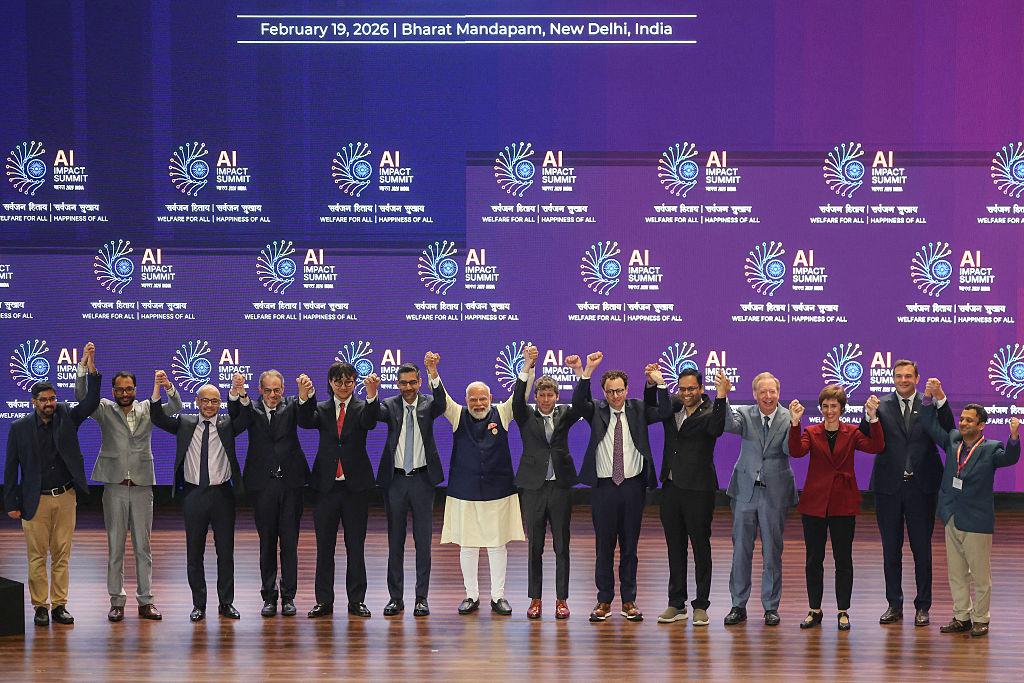
Prime Minister Narendra Modi met leading founders, investors, and policymakers at Seva Teerth in New Delhi during the India AI Impact Summit. The roundtable focused on artificial intelligence and deeptech growth. More importantly, it aimed to align public policy with startup ambition.
At the start, Modi set a clear tone. He asked entrepreneurs to build technology that solves real problems. For example, he highlighted agriculture, healthcare, education, manufacturing, and climate resilience. He also urged startups to think at a global scale from day one.
Founders from AI, robotics, biotech, space technology, semiconductors, and quantum computing joined the discussion. In addition, venture capital leaders and senior officials took part. Together, they examined how India can lead the next wave of innovation.
Building Strong AI Infrastructure
First, the Prime Minister focused on infrastructure. He encouraged startups to develop domestic AI models and computing systems. Instead of relying heavily on imports, he pushed for stronger local capacity in chip design, cloud systems, and data platforms.
At the same time, founders raised concerns about limited access to high-performance computing. Many young companies struggle to secure affordable GPU resources. Therefore, participants proposed public-private partnerships to expand national compute capacity.
Modi responded with urgency. He asked ministries to review approval systems and funding channels. Moreover, he stressed the need for secure and ethical AI systems. According to him, trust will define long-term success in global markets.
Aligning Capital With Innovation
Next, the discussion turned to funding. Early-stage founders described uneven capital flows in global markets. Meanwhile, deeptech startups explained the long timelines required for research-heavy products.
Because deeptech innovation demands patient capital, entrepreneurs requested stronger domestic investment participation. In response, Modi pointed to government-backed funds and incentive programs. He encouraged startups to align with these schemes and use them strategically.
Furthermore, several participants asked for simpler compliance systems. Lengthy approval processes often delay testing in drones, biotech, and autonomous systems. As a result, founders lose valuable time. The Prime Minister directed departments to explore single-window clearance systems.
Startups as Strategic Drivers
Beyond economics, Modi framed startups as national growth engines. He connected deeptech development with economic resilience and security. Therefore, he asked founders to focus on long-term capability instead of short-term valuation.
For instance, AI entrepreneurs showcased multilingual language models trained on Indian data. Similarly, healthtech startups demonstrated AI-driven diagnostic tools for rural communities. Agritech founders presented analytics systems that help farmers manage risk and boost yields.
During these presentations, Modi asked direct questions. He examined export potential, cybersecurity safeguards, and scalability plans. In addition, he emphasized intellectual property protection. He reminded entrepreneurs that global expansion requires strong digital security frameworks.
Strengthening Research Partnerships
Another key theme involved research collaboration. Modi encouraged stronger ties between universities and startups. Specifically, he proposed fellowship programs that connect doctoral researchers with early-stage companies.
Likewise, founders suggested shared labs for semiconductor prototyping and robotics testing. Such facilities can lower costs and reduce duplication. Consequently, startups can innovate faster.
The Prime Minister supported these proposals. However, he asked stakeholders to define clear milestones and timelines. He urged state governments to compete in attracting deeptech investment through better infrastructure and talent programs.
Expanding Talent and Skills
Talent development received strong attention. Startups face intense competition for AI engineers and chip designers. As demand rises, skill gaps widen.
To address this challenge, Modi encouraged partnerships between industry and universities. He promoted apprenticeship models that provide hands-on experience. Additionally, he highlighted digital learning platforms that expand access to advanced training.
Entrepreneurs also discussed global talent mobility. They requested smoother visa processes for international researchers. At the same time, they sought support for Indian founders expanding abroad. Modi acknowledged these needs and stressed the importance of balanced global partnerships.
Driving Global Leadership
Importantly, the roundtable emphasized exports. AI founders reported rising demand from Southeast Asia, Africa, and the Middle East. Indian startups now compete in markets that seek affordable and scalable solutions.
Therefore, Modi urged companies to meet global standards and certifications. He encouraged founders to treat compliance as a growth tool rather than a burden. He also positioned India as a responsible voice in global AI governance.
Because India operates at massive digital scale, it can shape inclusive technology frameworks. The Prime Minister asked startups to participate actively in international forums. In doing so, they can influence emerging AI norms.
Encouraging Cross-Sector Collaboration
Innovation rarely thrives in isolation. For that reason, participants discussed cross-sector partnerships. Climate tech companies explored AI-based energy optimization tools. Meanwhile, robotics firms examined precision agriculture applications.
Biotech startups shared AI-powered drug discovery models. These examples showed how deeptech fields intersect. Consequently, collaboration can unlock stronger commercial outcomes.
Modi reinforced this ecosystem approach. He urged founders to break silos and pursue joint projects. By combining expertise, startups can accelerate both research and commercialization.
Clear Signals for the Ecosystem
Overall, the roundtable sent a strong message. India intends to lead in AI and deeptech. More importantly, the government plans to work closely with entrepreneurs.
Investors observed this alignment with interest. When policymakers and founders collaborate, confidence rises. As a result, capital flows more steadily into innovation sectors.
Participants left with defined next steps. Ministries committed to follow-up sessions on infrastructure and funding. Startup representatives agreed to create working groups that track implementation progress.
Conclusion
In summary, the AI and deeptech roundtable at Seva Teerth marked a pivotal moment. Narendra Modi brought key stakeholders together and demanded measurable action. He called for faster execution, ethical design, and global ambition.
India’s startup ecosystem continues to grow across sectors. However, sustained leadership will require coordination, capital, and talent development. This summit strengthened that foundation.
If stakeholders deliver on these commitments, India can secure a leading position in artificial intelligence and frontier technology. Ultimately, collaboration between government and entrepreneurs will shape the next chapter of India’s innovation story.
Also Read – One-Feature Startups That Scaled Big